V. Materials and methods for the drafting of the MSSA Archiving Policy
- Isabel Cáceres, Museo de la Solidaridad Salvador Allende, Chile
Presentation
The Salvador Allende Solidarity Museum Archive (MSSA) was structured in 2014, after the retrieval of a large number of the documents on its administrative and museologist management between 1971 and 1990[^2]. Its rich heritage considers about 10,000 different typology documents, which classification and organization represents the different stages of the museum: Solidarity Museum (Museo de la Solidaridad, 1971-1973), Salvador Allende’s International Museum of the Resistance (Museo Internacional de la Resistencia Salvador Allende, 1974-1990), Salvador Allende Solidarity Museum (1991-up to date) Pic. 1. To this, a library with catalogs, books and magazines of different topics from modern and contemporary art collection, to its artists, curators, museum agents, as well as archive collections from people connected to the museum in one moment or another is added.
The institutional approach of preservation, dissemination and activation of historical documentation has allowed the MSSA Archive to give continuity to the development of its holdings and documentary collections, promoting the research, developing of archive exhibits, disseminating of its heritage and doing, placing themselves as a source of knowledge to a generation which were part of the museum’s history and it’s a one-of-a-kind collection Pic. 2[^3]. Also, the museum has fostered the development a scope with a wider approach on the archive, placing it on its custody role, considering it a key agent that promotes the activations of its sources in multiple practices, more in line with the contemporary look on the archive and adhering to the Universal Declaration of the International Council on Archives (ICA, 2010) in terms of easing the access to documents for cultural, administrative or democratic purposes. In this new viewpoint, we have resolved developing projects that promote the collaboration among archives, museums and/or documentation centers with similar characteristics and objectives, with the aim of creating collaboration networks as a strategy for the dissemination and strengthening of the missions and work, with an emphasis on what is established by international organizations such as IFLA (2009) and ICOM (2008) [^4]on the perks of collaborating with society. Both perspectives are addressed in order to conceive their role as key in the promotion of culture, collective memory, identities and social development, rather than mere custody. The fundamental idea is synthesized in that Museums are created by people to the people (ICOM, 2008) in the same way the Archives are created by the People for the People.

In this context, during 2017 and 2018, the MSSA Archive started the creation of its archive policy, with the aim of clearing up its mission, objectives, principles and processes. Behind this effort, there is a need for a professional strengthening in the MSSA Archive Area and for it to become responsible in the custody of documents. Both aspects seek protection within the international guidelines on proper practices developed by the ICA and councils and associations of countries that carry an archivist tradition.
To start this process, a document has been prepared which addresses theoretical-practical formulations on archives and particularly museum archives, gathered from specialized bibliography, work group documents on museum archives and versions of museum archive policies from appropriate institutions. Its objective is to have in hand conceptual and methodological tools for the stages of drafting, discussion, evaluation, agreements and decision making and formalization in regards to the MSSA Archive Policy.
< q-figure-group grid=“3” id=“14,15,16,17,18,19” caption=“Pic. 3: MSSA Archive is an active area of the museum, it serves different purposes and activities, from the remote access to its holdings and collections, the dissemination of the investigations, and the publishing of its policies and support to exhibits.">}}
}}
1. Scope of the museum’s archive and its practices
The organizational and functional actions consider the activities that are developed by the institution, as well as the purposes and principles that are guided and expressed in the documents that are being produced and gathered daily. In the process of production and collecting, action and decision making, testimonies as well as sources of memory, identity and history can be encountered. Any organization is capable of gathering and using documents, which in themselves, have the chance to be interpreted, valued, transmitted and rewritten in its history, past and present. In the museums, the same happens. The documents that are created daily become relevant in the actions and decisions making in a given moment, as they nourish and help take action on future steps that build history and “give life” to collections of different types. Some characteristics of the archival process, such as preservation, organization and access to the documents or collections of a museum that are established in the Museum Archive have a huge impact on the enrichment of the museum’s mission. This is achieved by allowing other communities, external to them, to have the chance of valuing it, enriching its contents, analyzing and providing interpretations from different perspectives. This also gives the opportunity to the members of the museum to have in hand its history and improve its management. In case some of these museum archives got lost, probably we would be losing a large part of items that define the cultural and artistic policy of a country, region, institution, community, as the access to organized information. Collections and museums would have little meaning and would lose their role in History. In this light, at least three elements show the meaning of the Museum Archives: Meaningful Development of its Heritage when addressing the systematic way in which they gather the documents; allowing its use for research of diverse matters by different communities; and, parallel fulfilling with the legal requirements or codes of ethics[^5].
The museums are known for their roles in preservation, research and dissemination of their collection “objects”, along with different programs and activities that they offer. These are part of their operations center and attention. However, holdings or document collections from their own organization, as well as possible incomes of groups of documents from artists of their own collection, for example, allows the museum to increase its heritage and take advantage of their object collections. This allows for the pieces and artwork from the museus to have more content, as they reveal its socio-cultural complexities in different ways due to the fact that they are understood as produced devices in a determined cultural and social context both in its creation and to its museum exhibition. Documents, as part of that system, are living images of the “life” of these objects and also, they show the truss behind politics or institutional management principles that are part of a museum collection (Pic. 3). Its whole process from creation, moving, sale, auction, donation, appropriation, steal, exhibit, roamings give to the actual work and collection a meaning that can be analyzed and studied from diverse perspectives: historical, political, socio-economic, geopolitical, from its gender, migration, cultural networks, intellectuals, among others[^6].
From that same perspective, when the museum institutions are put under the lens as a set of its management dynamics that are given within their administration and based on local national and international policies, as well as for their fields of actions, the documents become a source of research, both for the members of the museum as well as for any given audience. The museum could then become a “laboratory of knowledge” and widen its framework of action in virtue of its archives when presented in an organized and accessible manner.
In this sense, it is revealing that the most acknowledged museums have their own robust and developed Archive systems and policies within the lines of their statutes. For example, as a global reference, the NYC Museum of Modern Art, MoMA, that has preserved its exhibition archives, shed light on the history of its contemporary exhibitions: “One more time, the documentation reveals in many cases the field of origin of modern art history and in many sense, establishes the canon for said study. Besides the evident displays devoted to Matisse and Picasso, the exhibit archives also reveal how in mids-century, it was not uncanny for the MoMA to stage exhibits surrounding non-western or non-modern themes. The idea was to show the continuity between past and present, and the historical similarities; the “primitive” and the modern art expresses fundamental human concepts”.[^7]
The intensive use of the museum archives in recent research made by Latinamerican Art Historians, has had an impact in their investigations and methodologies, thus, searching in these archives for artistic-political clues and inquiring on the artists’ private archives in the museum, revealing a certain power in the critical causes of Latinamerican art, taking into consideration the difficulty to unfold or connect with Latinamerican artists that are not present. “The archives have been sacralized and at the same time “disorganized” to put the canon, the institutions and the built-up history as the core of the main question. Now, as never before seen, they constitute the repository which enables us to write other histories, specially when art is understood as critical analyses that puts in tension the artwork with the sources and contexts, and not only with style traits. These re-reading alternatives multiply geometrically with the chance to expand the constitution and use of the archives”[^8]. The paradigmes surrounding the archive, from the mere custodial to becoming a critical interpretation source of artistics and cultural processes, promotes -in the face of a “new” figure of the museum’s archive-, the chance to questionne its role, responsibility and statute considering its importance, safety and access.
In this sense, understanding the archival practices in the development of a museum archive there are consequences to be met, not only at the level of the documents corresponding to the artwork, but also in the institution’s own history and context; it implies a responsibility and the addressing of an ethical matter that sets the tone for the whole documentation custody, from its creation until they are filed to the archive. For example, the management archive model from the Museo de Artes Contemporáneo de Barcelona (Museum of Contemporary Art of Barcelona, MACBA), pays such a detailed attention to the idea, the work process, up to the staging an exhibit: “With the aim of including in the archive all those documents that allow, in the short and long run, to study the aspects of the creation process of the exhibit and not only value them by its result or final product but rather all the documents within the showcases presented in MACBA”.[^9] In this example, the archival exercises on the document’s value in the exhibits consider the “provisional documents” produced in the wok process that has a permanent value (historical-cultural); that is to say, they are not scrapped out and are given a key role, contrary to what happens in other institutions that they preserve them -if they do it-, as documents that result on a exhibit. The outcome from that work offers the Archive a record that will have: documents composed by the artists’ and workpieces listing, the staging and the processes of a photographic exhibition, the curatorial drafts, but the curatorial, intellectual and management exercises, as well as the drafts, blueprints of the rooms where they are displayed, curatorial meeting transcripts, provisional artwork listing, catalog models, room sheet drafts, among others. The axis for this assessment will focus on “making visible” relationships within the workframe that leaves a testimony and an access to those documents.
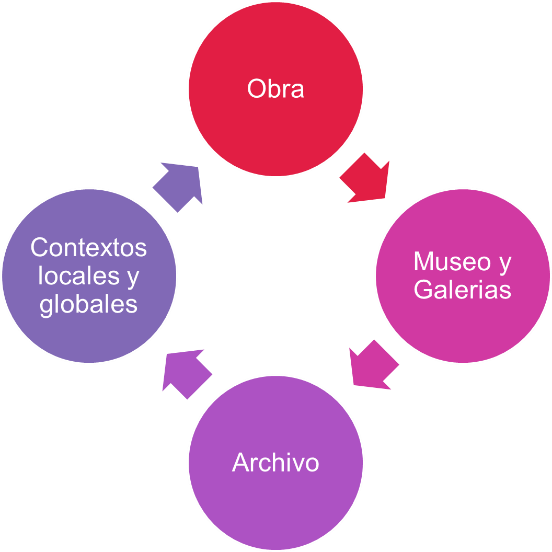
Another important item, is the improvement of the management of collections by facing responsibly the process of gathering, management and access to the Museum’s Archive. This, strengthens the disclosure and educational value of the exchange, and could prevent a a “leakage” or privatizacion of high content archives, and could also avoid a centralized benefit from those communities close to renown cities, artists, cultural agents and curators.
In Chile, the text Política Nacional de las Artes de la Visualidad 2017-2022 (National Policy for Visual Arts), edited by the Consejo Nacional de las Artes y la Cultura(Arts and Culture National Council), coordinated with different agents from the Visual Arts addresses the issue on institutionality. In the chapter ‘Museum, Documentation, Archive and Heritage’, a discussion arose from the importance of setting a general policy on archives in the field of visual arts, as well as establishing common grounds for its maintenance and access: “The general view was that working on the piece is not enough, multiplicity of process and objects that are part of the heritage need to be taken into account as part of the heritage, as well as exhibit programs, catalogs, documents that are link to curatorship, technical documents on the staging of pieces, among others”.[^10] This document highlights the value of documents associated with artworks and the role of archives for the knowledge of the piece and as a hinge to citizen and specialized access”[^11].
2. Museum Archive
A hegemonic definition of Museum Archive states that it is the one which identifies, preserves and manages systematically historical value and permanent documents with administrative, legal and research assets, and “gives recommendations on policies and procedures for its creation, mainaintance, and the retrieval or final disposition of the common use documents of the museum in any sort of device or format.[^12] Its purposes can vary from preservation to management of historical museum documents of value. Serve as support for the administrative, curatorial and programming management, as they positively impact the present and future activities of the institution. Give wide access to its sources for the sake of knowledge”[^13].
The archive helps to support the museum’s mission in its responsibility to preserve, disseminate and understand the one-of-a-kind heritage assets. It preserves legal, official, administrative and curatorial documentation, which must be organized and described. Also, documents related to artwork reinforce the museum’s functions as an investigation and debate center, as well as a disseminator for the art, the streams of thoughts and the culture”[^14].
3. Development of the Museum Archive Policy
The Archive Policy is a “set of rules and proceedings from archivist organizations used with the aim of managing all the organization’s operations”.[^15] More specifically, a Museum Archive Policy describes the functioning parameters of the Archive, as well as a comprehension statue for the museum in order to set standards, contents and ways in which they develop their archive holdings that goes in hand with the museum’s mission. The creation of an Archive Policy is key for the establishment of an archive in any given institution. Its drafting must be considered not only as an inaugural step, but also as a declaration of institutional commitment to carry out all the processes required and to which every member must be aware of.[^16] Though there are handbooks and guides that show the step by step in the archival organization, the creation of a policy results in an appropriation of ethical and cognoscitive aspects on the documentation work that preserves or that is capable of being preserved within the Archive, is from that point on that decisions and interventions become meaningful:
The creation and implementation process of a policy is way more important and beneficial for the museum than the policy itself. The policy might seem as a final result, but in reality, the final result is a deep understanding of the ethics and procedures that influences the museum’s functioning. There are many ways in which policies can be created. Each museum has its own set of challenges that need to be considered in the formulation of policies. Museums are encouraged to take their time to explore the circumstances and articulate them with precision in their policies. The policy-making must be integrated in order to be efficient. Each of the museum’s official documentation must communicate in a consistent and integral manner to support the museum’s mission”.[^17]
The time and space an institution takes to think on their own policies is what makes the difference[^18], as it is at that moment, that responsibilities will be defined, and where the purposes and the objectives to develop its holdings and collections will be set. This, in line with the criteria or previously established guidelines, which will be of great value for its community, regardless of its type, by placing themselves in a “reflective and well administered”[^19] stance. An Archive without a policy could, for example, overpopulate its collections without a given purpose, leave holdings or relevant documenting collections empty, allocate resources to non-meaningful material in their already existing holdings or, in the case of the museums, resources and efforts could be misplaced that would not protect in optimal conditions the collections or would affect the organization of institutional archives of historical meaning for the management of collections of its artistic heritage, which could negatively affect the research and the development of preserved artworks and/or heritage[^20]”.
A museum that drafts an archive policy through its specialized area, which at times can be its documentation center, library or collection area composed as an area or by its staff[^21], allows them to have an active role in the face of documentation heritage specially for art archive market or in the offering of an artists donation, and it clears any doubts on acquisition, incoming of its materials and its purpose. Last, for a policy to have an effective impact, it needs to “acquire a meaning and evoke respect, which will become a key part of the Archive’s live; it must be an object of effective promotion and respect in itself in the hierarchical scale”[^22], otherwise it would tend to become a dead end in the long run; there lies the importance of being reviewed and approved by everybody, and being actively socialized.
The objectives of the Archive Policy of a Museum archive can be summarized as follows:
-
Identifying the mission and vision of the Archive in accordance with the Mission and Principles Declaration of the Museum.
-
Establishing the specific and strategic objectives of the Museum Archive.
-
Determining the reaches and objectives of the development of its holdings and documenting collections, and its relationship with the artworks.
-
Specifying the determined and permanent processes in the time of the Archive’s development.
-
Exposing and directing practices and daily actions in regards with the documents that are added to the different holdings.
-
Establishing functions and responsibilities of all the team members.
4. Steps to develop an Archive policy
The contents in an archive policy are specific to each museum and its creation must take as much time as it needs in order to consider all the topics they aim to address, according to its own characteristics. During the Archive Policy elaboration of the MSSA, the following stages took place:
-
Institutional analysis and designing of a conceptual framework: Each museum has its own approach, mission, work collection, history, work teams, types of documents, strategies and different programs that must be fully studied considering the principles that guide the institution with their written or oral information. The objective of this stage is to accomplish a general framework of knowledge in regards to the museum in those aspects and the documents it preserves. Reviewing the internal and external normative context, holdings and collections’ characteristics, types of audiences, staff, infrastructure and financing.
-
Policy design: Start with the selection of chapters considering the type of pre-existing collection and what is planned to develop taking into account the fixing of objects, the associated practices, the work flow, the challenges of the archive, among others. The policy extension of the Archive can vary. Some recommendations are creating a clear, direct and simple language, which can become more useful than one far fetched and over explanatory; redundancies must be avoided. Sometimes the drafting can be collaborative if there is an Archive Committee doing the drafting and later on, the reviewing.
-
Evaluation: This relates to the process in which the Archive Policy is posed to evaluation by a committee composed by the members of the museum in that stage: Direction, Collection, Preservation, Administration and Archive.
-
Officialization: Stage in which the Archive Policy is approved for its implementation and it is disseminated through key media, both inside and outside of the institution with the objective of being recognised by the audience.
-
Implementation: Referring to the moment in which tasks and programs destined to consolidate the purposes of the policy are executed and taken into account for the whole archivist doing.
-
Reviewing: It refers to the set time for the publishing of the policy until a reviewing is established, generally every two years.
5. Elements of a museum archive policy.
During the stage of the policy’s design we lay a set of questions that we consider to be relevant for the creation of the policy. This also allowed us to identify a “stat” on the Archive’s situation, and give priority to certain elements, and leave some of them for future reflections. It also helped us to identify the things we cannot become responsible for. We present some examples[^23].
Are we clear on the role the Museum Archive plays? Has it been reflected, grounded and described the Archives mission and objectives? Are the functions within the Archive known? How ready and well prepared are we to fully assume a sustainable task of custody and preservation of the documents that reach our domain? Do we have a workflow or management model for the archival work, coordination of the registry, description, access tasks? Do we know the profiles and specific competences that we require? Do we count with a procedures handbook that draws the line on the tasks by area and its processes? Does the Archive staff have the capacity, support and sustainability to develop their tasks? Does the archive find itself with a documentation system management that allows for a centralized classification, ordering and records transferring? Are the criteria and means of acquisition of the documents known?
It was also part of the MSSA Archive Policy Design, the reviewing of Archive Policies from other museums around the globe considering: mission, staff, selection and assessment, acquisition, ordering, description, security and access, programmes, disaster plan, preservation policy[^24]. During that thorough process, we did a comparative chart where we considered those aspects that were more relevant to our already existing document collection and to our understanding of the archive, as well as seizing the opportunity of what goals we wanted to achieve in an institutional level, resulting in a first conceptualization of the characteristics and terms of an Archive Policy (Pic. 4).
Some general chapters in the bibliography consider:
Introduction: Terms of the MSSA Archive Policy and its Objectives
Mission: Declaration of fundamental objectives or the raison d-étre of an Archive that has as a goal to enrich the commitment and history of the Archive.
Vision: Main statement on the positioning of the Archive in the long run, what it is expected to be in the future.
Purpose: Declaration of main objectives of the MSSA Archive.
Responsibilities: Set of actions that the MSSA Archive undertakes and can be accountable for.
Team structure: Associativity among the staff members of the archive which determines their responsibilities, functions, activities, and common objective tasks.
Definitions: Nomenclature associated with the policy of common use in the Archive.
Reach: MSSA Archive and its organization attribute descriptions, that provide an understanding of the different legal, administrative and cultural areas.
Acquisition: Guide for the process of documentation acquisition of the MSSA Archive.
Assessment and elimination: Definition of the assessment criteria for the holdings and documentation series. It determines which are the documents of importance for the record treatment of the Archive.
Organization and Description: Consider the principles that guide the organization and description of the holdings and MSSA Archive collections, mentioning the scientific principles and international standards.
Record Management: Determines the criteria, reaches and objectives of the organization’s establishment of a Record Management program in the MSSA and the management of the life cycle of the institution’s documents.
Access and use: Marks off the ways in which members of the museum and external users access the material.
Preservation: States the localization and preservation media, record conservation process and disaster plan.
Guidelines for specific procedures: guides that accompany the policy.
Museum Archives. An introduction |
Starting from Scratch: How to Create a Museum Archives. Sammie Morris | Sample Records Management Policy. Museum, Libraries, Archives. London | MOMA | Cleveland Museum Archives. Accessioning museum records |
Record Management Manual. National Museum of women in the Arts |
TATE Library and Archive | The MINT Museum Archives Collection Management Policy |
|---|---|---|---|---|---|---|---|
| Definition (Records, Archives, Professional Papers, Manuscript Collections) | Mission statement | Introduction | Mission Statement | Introduction | Description of the Collection | Visión | Mission Statement and Purpose |
| Purpose | Access and use policy | Scope | Purpose | Record Types and Locations | Collection Policy: Official Records Personal Materials |
Misión | The Mint museum archives is responsible for: |
| Appraisal of record (Policy general) | Collecting Policy | Purpose | Structure | Records Transfer | Disposition of Official Records: Appraisal of Records, Records Dispositions Schedules | Purpose | Ethics |
| Disposal of records (Policy general) | Staff Records Policy | Definitions Record, Record Management, record management programme. |
Access | Records Transfer Form | Access and Restrictions to Archival Holding: Access, Restrictions, | Scope of the collection | |
| Records Management (Policy general) | Adquisitions Procedures | Responsabilities Senior Management, Record manager, managers, employees, human resources. |
Staff | Direct Transfers | Guidelines for weeding Records: Draft; Routine Correspondence; Memoranda; Financial Records; Minutes and Reports, Press Clipping; Reference Materials; Multiple Copies; Miscellaneous; | New Collection acquisition. Internal collections External collections |
|
| Cooperation with staff (Policy general) | Records Transfers Procedures | Policy | Definitions (Archives, Personal and professional papers, Manuscript Collections, Records) | Appraisal | Guidelines for transferring records to the archives | Collection Access (Physical Access) (Digital Access) (Reference Service) |
|
| Maintaining the order of records (Policy general) | Processing and Description Procedures | Guidance on supporting procedures, related policies and the regulatory environment | Responsibilities | Description | Guidelines for managing electronic records | Care of the Collection Environmental monitoring and control Conservation and preservation |
|
| Location of archives (Policy general) | Policies and Procedures for Destructions of non archival Records | Queries | Additional activities (Acquire, oral program) | Accession Records | Records Schedules | Policy revisión schedule | |
| Official records vs. professional papers (Professional papers and non-archival materials) | Record Management | Database Fields | |||||
| Mon Archival Materials defined | Manuscript Collections | ||||||
| Special Collections | Definitions of manuscript collections | ||||||
| Access to archival holdings (Other Responsibilities of the museum archives) | Criteria for new acquisitions | ||||||
| Restrictions (Other Responsibilities of the museum archives) | Access Policy | ||||||
| Physical security (Other Responsibilities of the museum archives) | |||||||
| Requesting dispositions of papers | |||||||
| Determining disposition of papers | |||||||
| Donating personal papers |
Pic. 4 Comparative chart of chapters of some Archive Policies Museum.
Bibliography**
Chaplin, E; Tullock, J (2015). Sucess guides Successfully managing archives in museum. Association of independent museum.
Elligott, M (2008). Perspective from the museum of Modern Art Achives, New York. Atlanti. (18) Trieste, 369-377.
Deiss, W (1984). Museum Archives: An Introduction. Society of American Archivists. Chicago.
Demb, S; Teuteberg, S. (2000). Record Management Toolkit. London Museums Hub. Museum, Libraries, Archives.
Duranti, L; Franks, P. (2015) Encyclopedia or archival science. Rowman by Rowman and littefield. New York. London.
Giunta, A (2010). Archivos Políticas del conocimiento en el arte de América Latina. Errata.(1). abril. 20-37.
Gutiérrez Usillos, A (2010). Museología y Documentación. Criterios para la definición de un proyecto de documentación en museos. Ediciones Trea. Gijon, España.
Mckellar, S (1993). The Role of the Museum Archvist in the Information Age. Archivaria. (35).
Morris, S. (2006). Starting from Scratch: How to Create a Museum Archives. Research Publications. Paper 45. http://docs.lib.purdue.edu/lib_research/45
Mignolo, W. Activar los archivos descentralizar a las musas. Cuadernos portadillas. MACBA.
Museo de Arte Contemporáneo de Barcelona (2014). Folding Exhibitions.: MELA. Barcelona.
Museum of Women in the Arts. (2011 November) Records Management Manual. Institutional Archives.
Society of American Archivist. Museum Archives Guidelines. https://www2.archivists.org/groups/museum-archives-section/museum-archives-guidelines
The national Archives (2018, marzo). Writing a Collections Development policy and Plan.
Vicent, S. (1996) Gestion, traitement, conservation et diffusion des documents dans les musées: la place de l’ archiviste. Archives (27-3). 53-77.
Whyte, D (Ed.) (2004). Museum Archives. An introduction (2ª ed). Society of American Archivists, Museum Archives Section
Yarrow, A; Clubb, B.; Draper, J. (2009) Bibliotecas públicas, archivos y museos: tendencias de colaboración y cooperación. Federación Internacional de Asociaciones de Bibliotecarios y Bibliotecas. IFLA profesional Reports (133).