VI. Imagoteca: la colección de imágenes sociales y políticas del CeDInCI. Reflections on its construction
- Natalia Efron, CeDinCi, Argentina
- Eugenia Sik, CeDinCi, Argentina
“Every catalog is a machine to trap reality. It is also an expression of the thirst for knowledge or, even more modestly, for fixing. Who catalogs seems to be a player and also an intellectual”.
(María Negroni, Pequeño Mundo Ilustrado)
First part
CeDInCI[^1] (Buenos Aires, Argentina) is a documentation center (library, newspaper library and archive) that focuses on the retrieval, preservation, conservation, cataloging and dissemination of political and cultural productions from the Latinamerican Left from its origins in the second half of the XIX century up to the present.
Its heritage gathers the largest document collection on the Left in Latinamerica, including the production of large political currents (anarchism, socialism, syndicalism, communism, Trotskyism, Maoism, Guevarism, the New Left and revolutionary nationalisms) as well as social movements (labor, student, women, human rights, farmers, artistic and intellectual movements). It also offers a large volume of documents, bibliographic and hemerographic collections of other political families (liberalism, radicalism, conservatism, nationalism, christian democracy, social Christianity, Peronism and other Latinamerican populism). It also has numerous art and literature collections, especially of those linked to political practices.
CeDInCI was born as a non-profit civil association devoted to the preservation of the documentary and cultural Left heritage. The initial collection was constituted based in the personal archive of the Argentinian historian Horacio Tarcus, gathered in a period of 20 years. In 1997, with the acquisition of the José Peniale Holdings, that gathered every piece of guild and clippings of political press from the first half of the XX century, the idea of transforming these large personal holdings in an open center for the public consultation emerged.
From the opening of its first head-quarters in April of 1998, this initial collection grew substantially thanks to donations, acquisitions and swaps, which adds to date 190,000 monographics (books, brochures and thesis), 10,000 press publications (magazines, newspapers, journals and newsletters) and 160 private archives holding. It also gathers a series of collections of over 4.000 political and cultural posters, as well as the largest existing collections of electoral ballots and flyers in Argentina (over 20,000 documents).
Currently, CeDInCI offers to the scholar community, as well as to the large range of readers, one of the biggest Latinamerican libraries specialized in social, political and cultural Latinamerican history. Likewise, thousands of collections of the most important press publications produced in our continent by political, cultural, union, student, human rights, women’s organizations, among others are available from its gathering.
In recent years, it has become the prime center for human and social sciences reference in the region. It regularly hosts researchers from diverse universities around the world, especially from Europe and America.
The heritage organization of the center is divided in two areas: the Newspaper Library and the Archive and Private Collections Library. Within the last, collections of flyers and posters previously mentioned are managed, as well as artworks, objects and memorabilia. Within the archive holdings, three major photographic documentation sets are encountered: the holdings of the already extinct newspaper La Razón (Buenos Aires); one from the amateur photographer Alfredo Alonso; and one from the journalist and writer Hugo Gambini.
History of the Imagoteca[^2]
The Image Library (Imagoteca) was created in 2016 from the institution’s practical need of disseminating documents that have already been digitized from different state-of-the-art work lines: projects, specific digitalization orders from CeDInCI consultations, among others.
Besides this pragmatic objective, in an effort to make visible graphic productions, the Imagoteca was constructed based on different Argentinian and Latinamerican political cultures, especially on those linked to r movements and organizations that were both alternative as well as revolutionary.
With this project, we seek to promote the consultation, research and reuse of images in order to place them as objects of study and not just as mere documentary sources.
The documents include: A photographic collection of over 3,000 organized and digitized documentary pieces, -found several years ago in the catalog of the library/depository (as in that time the archive catalog did not exist and was later on created in 2012)-. Also, the photographic collection, -composed mainly by archive images of La Razón and the Alfredo Alonso Holdings-, counts with hundreds of illustrations, newspaper and magazine covers, flyers and insignia (or “logos”) linked to different left political currents.
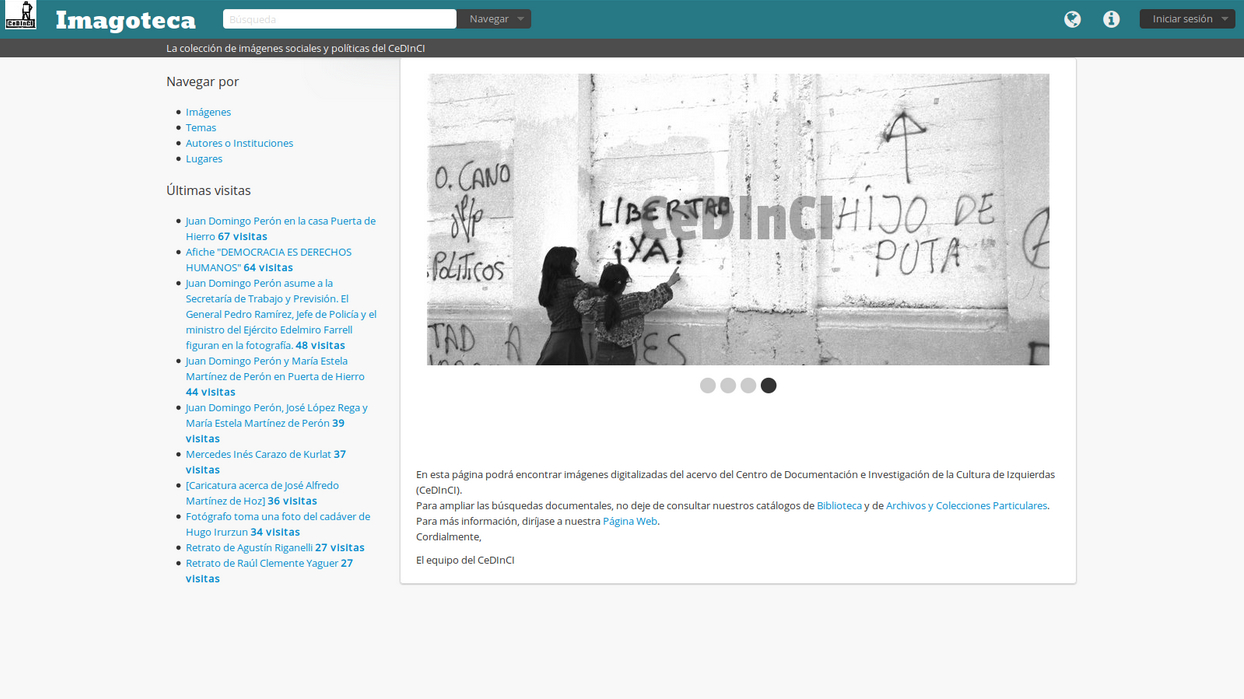
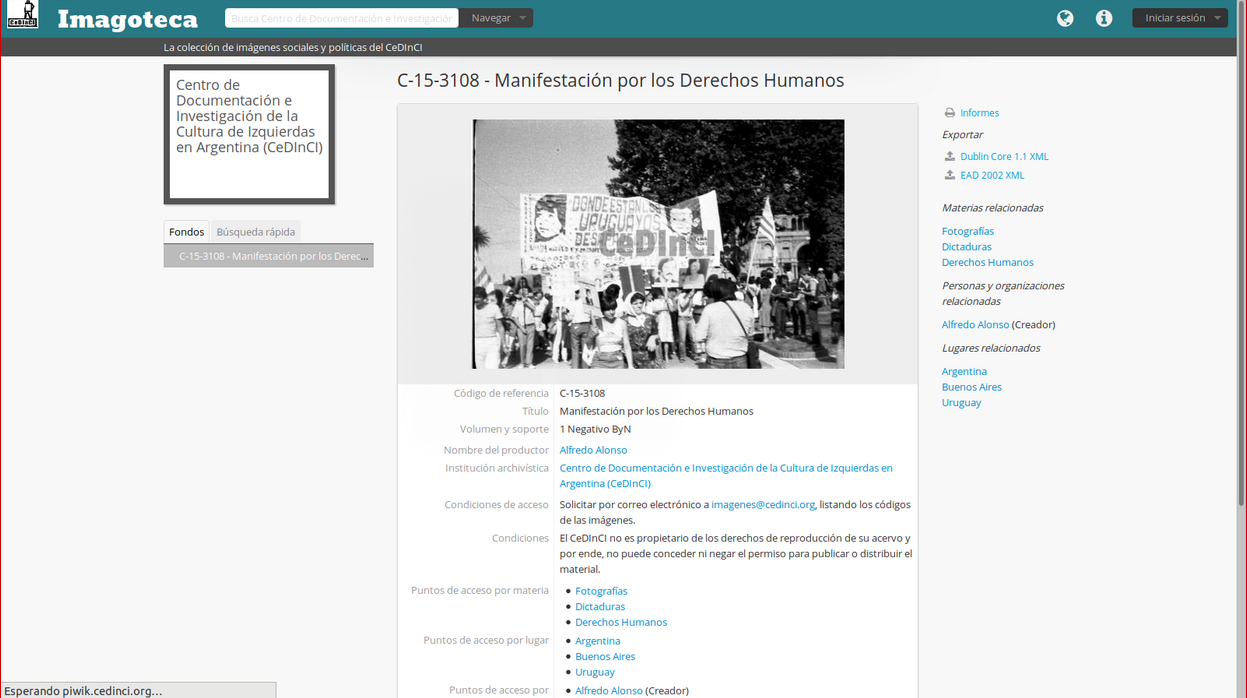
In 2016, to develop the Imagoteca the AtoM system was used, as in the past the Archive and Private Collections area of CeDInCI had already executed its guidebook in the same platform, which up to date, saves its multi level descriptions as well as digitized documents. In that opportunity, different softwares were evaluated, but we agreed that even though the system was not originally thought for the piece-by-piece document cataloging and that there were no other attractive options for the visualization of images, there were other liabilities that benefit us as a small institution that leads different type of projects:
-
As it was the same software, it was not necessary to add new requirements to create the database.
-
The slim web development required from AtoM (almost an ready made).
-
The ease of adapting certain items of the site.
-
The chance to export databases and digital objects in an automated way.
Over the years, the Imagoteca transformed into a database where people could look up specific images, but further documentation was not added.
Development and Implementation
In 2020, during the COVID lockdown, it became evident the need to increase the access to digital documents. Likewise, in the last years several documentary collections have been digitized which, in many cases, already had a set of created metadata. Among them:
-
Over a thousand political-cultural flyers (from a wider collection of over 3,000 documents).
-
Hundreds of photographs, specifically, digitized portraits from newspapers, books and archive holdings. Some of these documents were digitized after the publishing of the Diccionario Biográfico de las Izquierdas Latinoamericanas (The Biographical Dictionary of the Latin American Lefts, which also included illustrations and cartoons).
-
Hundreds of political-cultural flyers from different Argentinian political parties from the 70s to the first decade of 2000s.
-
Currently, there are over 700 photographs that were digitized and cataloged from the collection holdings which corresponds to a collection organized based on its editorial archives use: envelopes and thematic letters in alphabetical order.
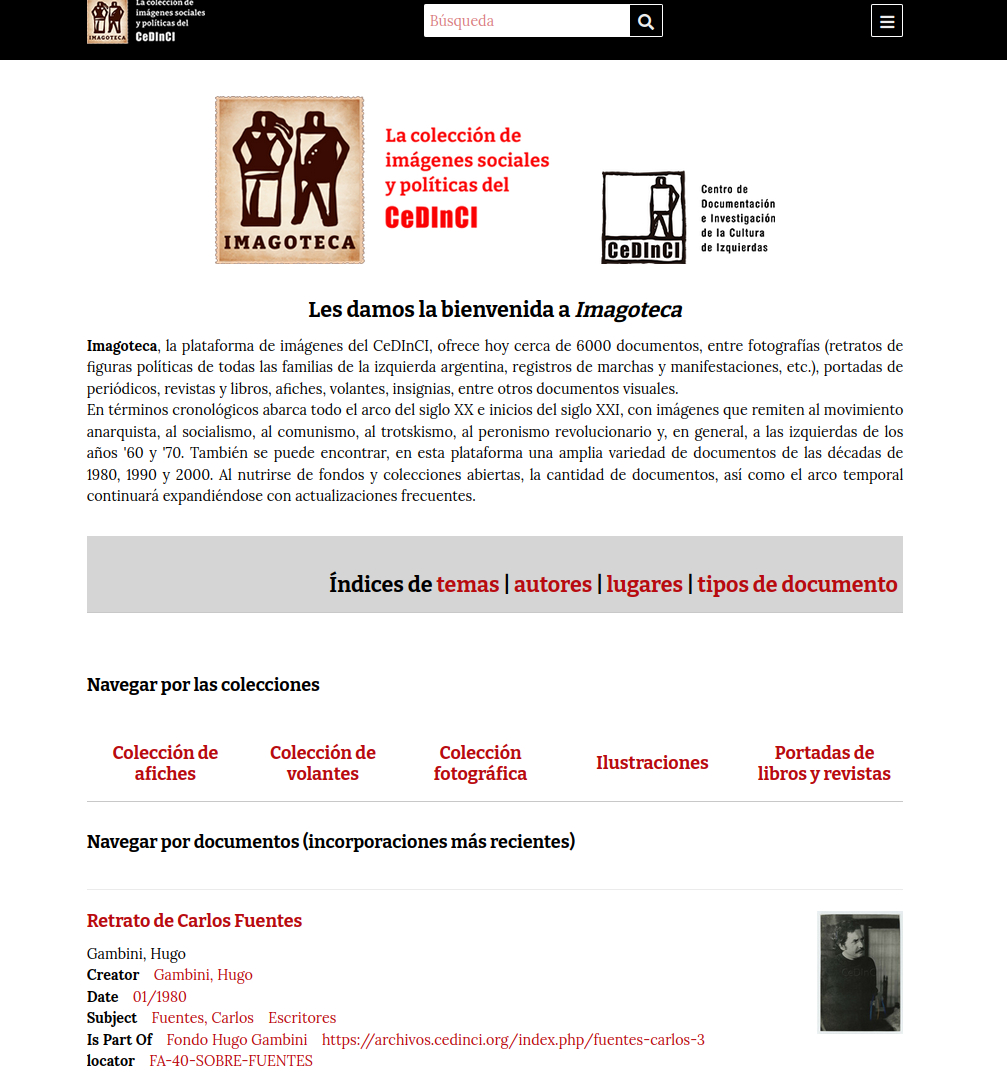
In regards to the software, in this chance the software Omeka version S (semantics) was chosen. This, because in 2018, in CeDInCI we developed a virtual exhibit website that allowed us to showcase online the different productions of the institution’s headquarters. For this exhibition site, the Classic version of the software was used, but now its S version was chosen as it enables the work of different metadata schemes that could be worked and developed. It also presents greater ductilides in the construction of a collection and the personalization of the fields, among other benefits.
Notably, once the system was installed by the IT Emmanuel Alcaraz, all the decisions related to the visualization of the site; its cataloging, the document selection and the migration of registers were made by those who are writing this work. This fact may sound anecdotal, but it became beneficial in terms of the dynamic found in a small institution, and for the possibilities it gave to correct and to improve the visualization and interoperability of the site in regards to the logged information. It also was an advantage in terms of the streamlining of the process as a whole. All of this was beneficial as it provided the chance to develop a great amount of tasks from the webs system interface by people who are not IT specialists.
First of all, we focused on the documentation presentation; we prioritized the images quality, its proper visualization, the chance of adding more than one digital object to a record, the feasibility of easily build collections and sub collections of different types, and the personalized construction of hipertextual search fields and indexes. Then, decisions were made in regards to the curatory as well as strategies to improve the already existing descriptions.
It should be noted that, as it is a working process that has been developed for years with different people, there are diverse ways of doing which seek to be unified and systematized. We tried to deepen on new ways of perfecting what has already been done but, at the same time, we attempted to make available as many documents as possible. Besides the pragmatic decisions to build a cataloging policy, the challenges of the task became clear and greater problems arose which led us to define the cataloging policy of a site and the development of the procedure manual (which already has a first version oriented towards the systematization of the fields used in the database).
Second part/Questions on the implementation of an image repository
During the development of the platform/repository we faced some methodological discussion and decisions on the creation and redesigning of the new platform, the cataloging of documents, the interrelation between existing archives, the establishment of work parameters that took into consideration the particularities of the documents and its possible uses.
For this reason, we want to discuss this integral work process considering the tensions between piece and document, the potential of the collections, the sensitivity and the archivist methodology, as well as the ways in which we describe (represent) visual documents linked to Argentinian cultural policies, specially, of left and social movements. We structured this considering the following questions:
Why build a curatorship of the images in a collection?
We are aware that this action goes in detriment of the integrality of an archive holding and, even though the selection is done virtually, it continues to be a cutout from a collection of documents organically produced. However, it became crucial to capitalize the previously done work, using other types of resources we had that were not online -as the Diccionario Biográfico de las Izquierdas Latinoamericanas portraits-, considering that CeDInCI is a documentation center with various collections and which receives donations but also other type of active documentation that cannot be found in other institutions in the country and the region (like flyers or posters). We started this project knowing that in the description of each document we should rebuild the relationship of it as a set, but also acknowledging that we needed to use a relational database that could transvesalize the searches (and the ordering of the contents), and promote the uses and overviews on the images.
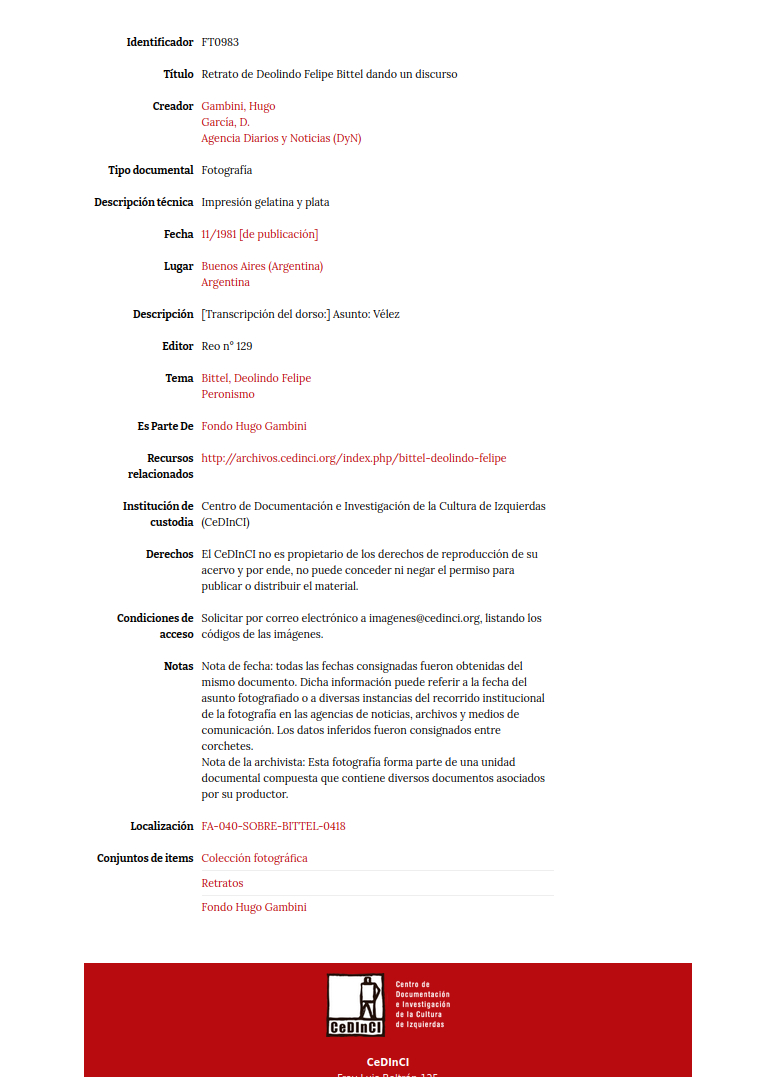
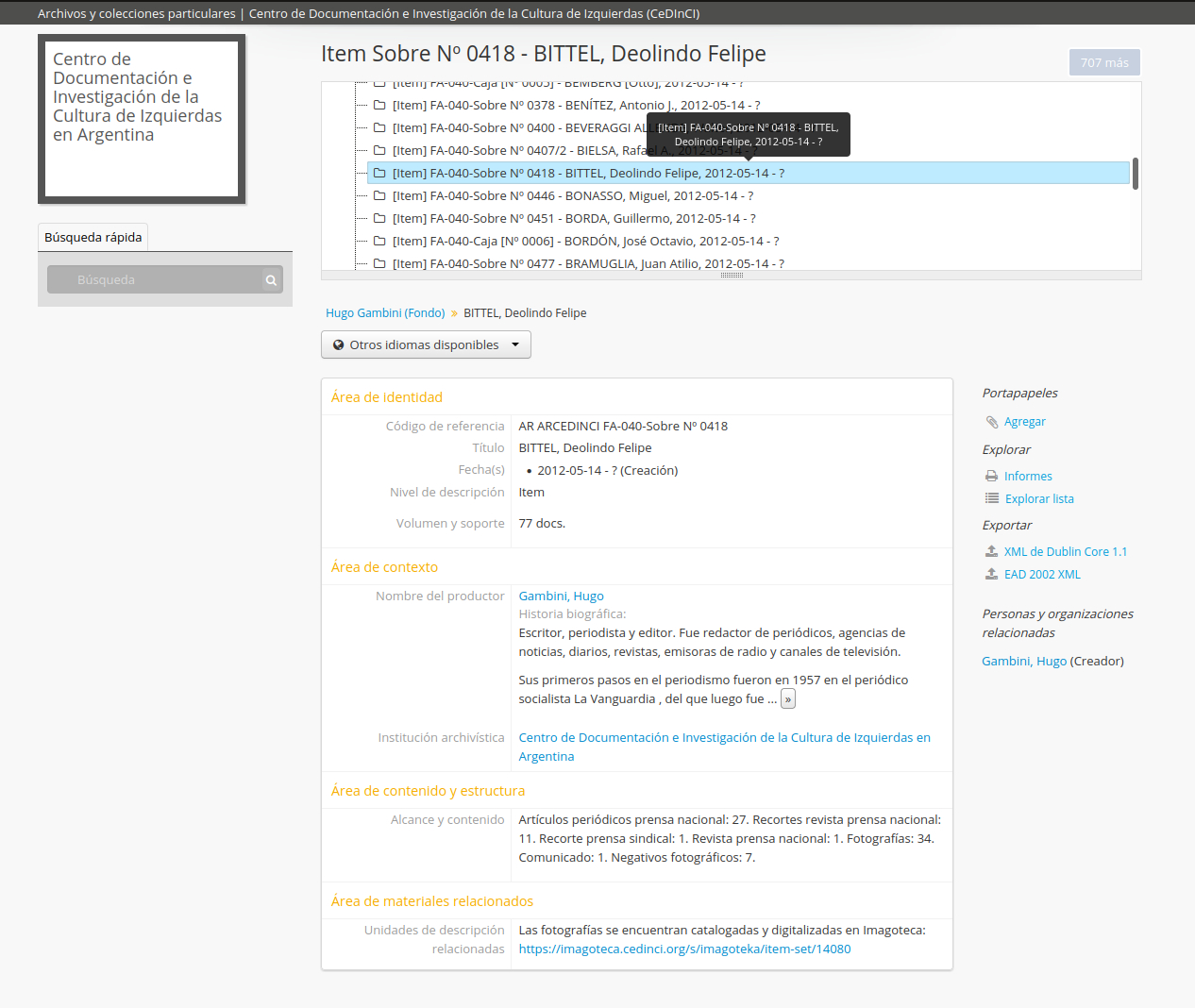
This cutout or “dismembering” was compensated with the interrelation of the registers from the descriptive fields (hyperlinked) that allowed to virtually rebuild the relationship of each image/piece with its associated documentation along other documents that are shared by the primary guard and with the Holding/Collection. For instance, in the case of the Gambini Holding (and in the La Razón Newspaper Holding) each picture possess a description field that could be associated with an specific envelope, as well as to the description of the holding in the archives’ catalogs and, from a collection created with the documents that are part of the same holding; also it is hyperlinked with other items of the same Holding/Collection within the Imagoteca. From the hyperlinks you can route the contents, themes, types of documents, geography, dates, among others.
2. When a Holding/Collection is composed of many types of documentation, how do we establish clear criteria and delimitations that allow us to select and develop the site?**
Immediately, the answer is obvious: the decisions made (and that will be made) in order to nourish the Imagoteca are considered in regards to each collection’s characteristics. Examples of the current challenges allow us to show which type of ponderations we are carrying out to continue with the site’s development:
-
In the case of Hugo Gambini’s Holding it was decided to digitize only photographs, as many of the other documents are part of other collections (e.g.: a newspaper article). Also, these non-visual documents that compose a holding’s envelope or thematic box are not related, in many cases, with the pictures found there and they do not contribute to its contextualization. Moreover, there are envelopes and boxes that solely contain pictures. Likewise, there is an interpreter that prioritizes the availability of photographic online documents since there are few online collections with visual documents available in the country.
-

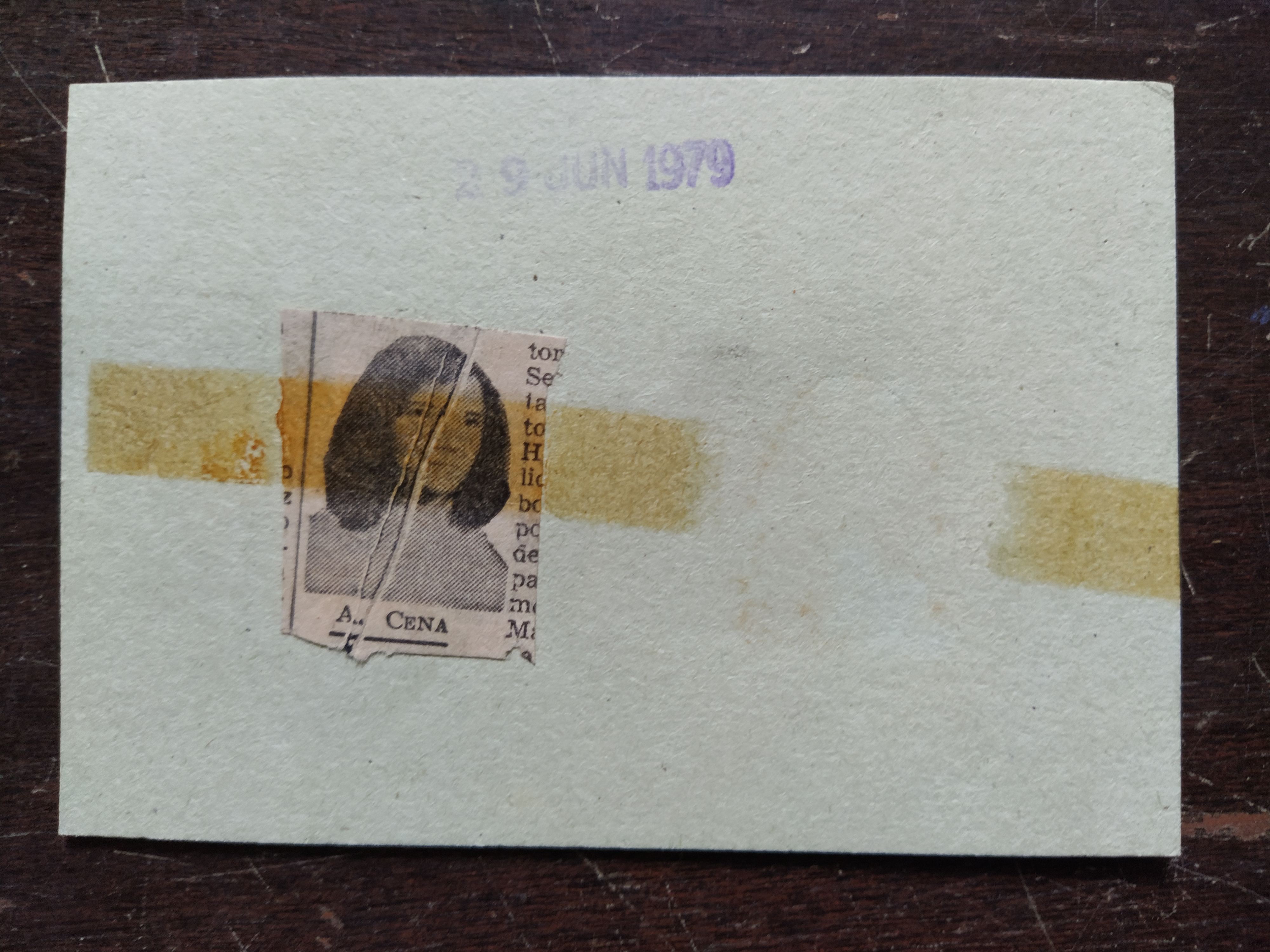
On the contrary, for over 15 years the newspaper La Razón only digitized photographic documents. But as it is a stricto sensu writing archive, with the years we have seen that it is categorical to incorporate documents that contextualize without any doubt the image, as the envelopes replenish publication data and the meaning behind the publication and recording of the photography(s). In Pic. 7 and 8, there is the example of an envelope we published of a missing woman in the Imagoteca. The newspaper clipping provides more information which the family of the victim was trying to find. The repositioning of this online information guarantees, in a more wholesome way, that citizens can access the archives and guarantee their rights.
-
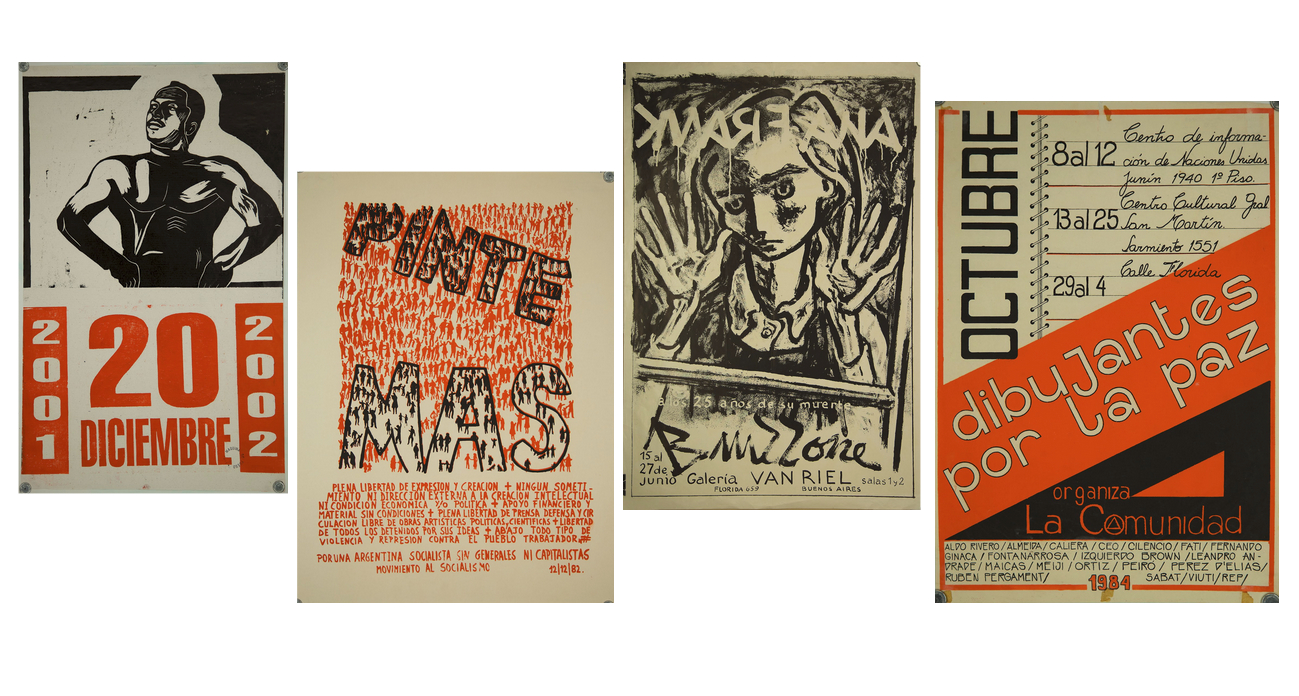
The collection of political cultural posters was created and guarded by CeDInCI and it is composed by different donations (whether or not they constitute an archive’s holding) and documents gathered by the members of the institution. In the case of this type of documentation, it is necessary to highlight the double characteristics found in the posters, as they are on one hand, artistic expressions and on the other, they are ephemeral documents with a merely informative character. In this case, considering the size of the documents, it was decided to digitize all the posters, regardless of its aesthetic value. We believe that documents with a larger visual work cannot be selected, as it would block future aesthetic overviews on the documents.
3. Questions and challenges in the image’s description**
When we started with the cataloging process of the images, we asked ourselves which was the best way to provide a description that could consider potential users, possible reusings and the typological diversity we could face.
One of the core questions was: Do we focus the description of the cultural object on formal, thematic or usage aspects?
Finally, we opted for the same metadata set for all documents as that would enable transversal associations of the different collections and types of documentation. Specific decisions were made in regards to the retrieval and systematization of the information of each grouping or private collections, in terms of the information it image possessed or was associated with. Among them:
-
In the case of newspaper photographs, whether they were published or were part of the composed documentary units, the information was taken initially from the associated documentations, or by the subscriptions in an envelope or the information taken from the same document/piece. Then, we moved on to the investigation: people are identified and descriptors from the institutional thesaurus are assigned, which help us to elaborate more accurate descriptions.
-
The flyers and posters have textual information that is crucial for the cataloging process. In the case of this type of documents other issues arise: the identification of the title (specially in posters), the convergent authorships in the same document, the date, among others.
-
How can we organize and prioritize the transcription of a text that does not have a linear reading and where the design and image become key elements for its comprehension?
After a first description that considers the information written encountered in the reading, a formal description order is done in some of the visual documents. In other words: we seek to describe the content of a document in a common language where other terms can be retrieved and which also allow the documents to become more accessible, specially for those with a visual handicap.
!
-
Another case that must be taken into account is the one of photographs. On several occasions, they present very opaque scenes that force us to deepen our understanding. Each description can turn into a research in itself that needs previous specific knowledge, not only in relation to the theme but also in the regards to its materiality.
-
For instance, it is not the same to catalog a picture made with offset printing that had an specific use (example: newspaper, magazine, poster or book) than a printed image on paper with gelatin and silver (a photography as we know or used to know until a couple of years ago) that could have been developed by the same author, news agency or the newsroom, something that could relate the process to a negative, a camara and maybe even in the direct connection with the portrayed momento or person. The materiality adds to the thematic approach a layer of information on the production systems and the uses of those images/objects we are analyzing. It also helps to differentiate a drawing made with ink, pencil, acrylic or to its reproductions by a mechanical system that requires a certain expertise. Then, it is necessary to build the information within the used metadata scheme.
That is to say, when describing this image we would have to have a certain level of knowledge in Photography, Arts, History, Archive and/or Library Science. We think it is imperative to work with interdisciplinary teams, give them time to research and even then, it might be possible we don’t get accurate and complete results. What do we do in such cases? We published the picture anyway even though we don’t have the basic information?
Under this observation, another tension arises from the useful and the unuseful. Is a picture without information useful? Is it necessary to do a “standard” description?
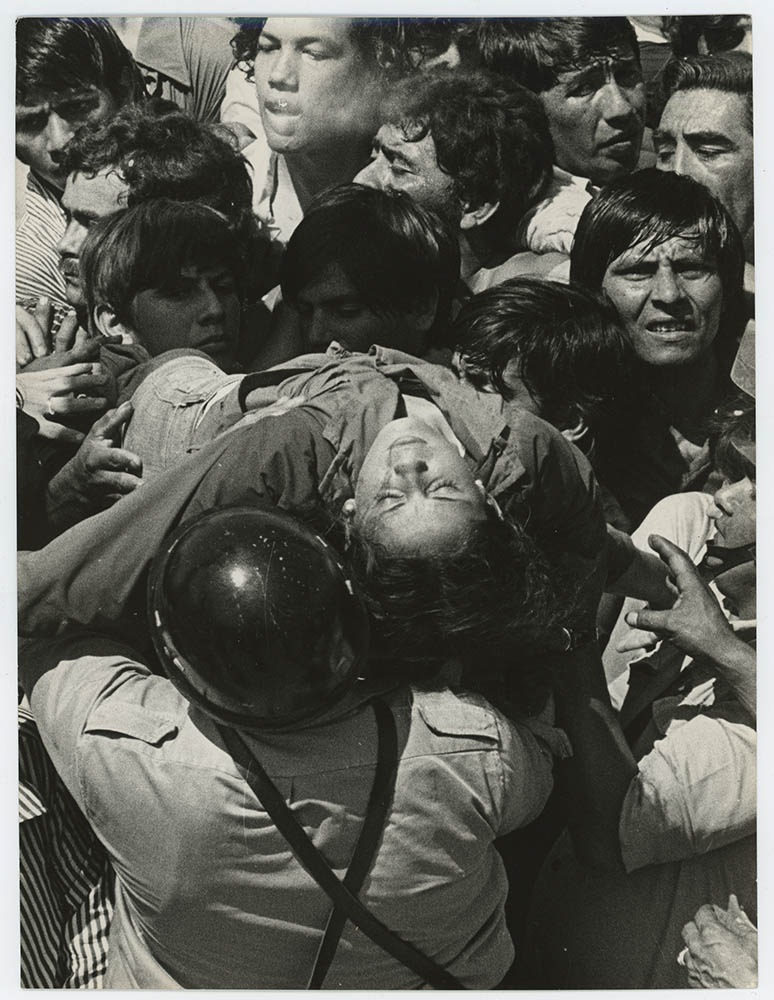
An example to reflect on these issues can be seenin Pic. 11. This is part of the Gambini Holding, and could be found under the title Guerilla along other 18 photographs with militar operative scenes and some are even connected to the Operativo Independencia. A possible title could be ‘Group of people raising a woman’, but the image does not clearly expose what is going on. Is the woman dead, fainted or has it been staged?
From the contextual information of the photography and the little breakthroughs in the research, we started to rebuild part of the information from the group of pictures from where we analyzed the image. Nevertheless, any aggregate to the first description could lead to a wrong reading and replica of the image. We could think of the following titles:
-
‘Militants recover the body of a fallen comrade in the battle field’
-
‘Group of people move the body of a fallen militant’
-
‘Staging carried out to justify the repression and military operations in Tucuman’
Even though the picture is in an envelope under the name Guerilla, it cannot be determined what type of scene is being portrayed or the roles the characters have in the picture. It is not clear whether the woman was a militant of the ERP (Ejército Revolucionario del Pueblo, grouping that deployed in the Tucuman Mount at the same date where the rest of the pictures have been registered on the composed documentary unit).
The way in which an epigraph, -in this case of a Title or Description in a database- conditions the reading of an image, has become a very discussed topic and it has been developed by different people who have devoted their work to the reflection and analysis of an image, like Gisèle Freund or Susan Sontag. Likewise, the real value of a picture is something that has also been discussed and which we will not focus on in this text. What we are interested in here is the tension generated by a trustworthy description and a skeptical description that does not show the complexity of the image.
On the other hand, combining times and institutional needs with an ideal description is no easy task and it is another variable that turns the focus back when it comes to addressing an image. How much time can we devote to the description of an image?
At the same time, the example of Pic. 11 invites us to reflect on the fine line between “over analyzing” and describing what is observed; what can be found on the surface. Without an accurate description that enables its direct or indirect encounter, images get lost.
4.1 How to enable reuse/reappropriation?**
Another issue that must be addressed is the creation of points of access. In this case, it becomes obvious that there is a lack of specialized language in regards to the Argentinian and Latinamerican political cultures. CeDInCI created its own conceptual categories in the library’s catalog, which was taken over by the Archive Area once the AtoM system was developed. Most recently, the experience of the Diccionario Biográfico de las Izquierdas Latinoamericanas[^4] and of the site Sexo y Revolución[^5] (Sex and Revolution) has led to a larger conceptualization in the definition of categories regarding political parties, social movements and the vital and identitarian experiences in a wider sense.
Due to this, it becomes necessary to create efficient points of access that can promote the link with other pieces/documents and which allow specialized and non-specialized users to approach the documentation. We strongly believe that in the Imagoteca, descriptors help to create an iconographic and visual tour related to certain events or themes, for example, the Trelew Massacre[^6] or the 1st of May.[^7]
We consider that the theme descriptors are not the end of the process. Besides accessing the archives by type of document, we believe it is necessary to develop a vocabulary that is in line with the printing processes and the characteristics of the documents, in terms of its physical and gender features.
Closing words
In this presentation we wanted to briefly review almost the entire development process of a site oriented to visual documents. We believe that through these sorts of dilemmas we can go deeper in why is prioritized a specific type of construction of a determined collection as what has been sorted out here is based on the different types of descriptions given to archive holdings. Likewise, we think which documents we want to make available, as we realistically approach them in regards to the times each institution has in its disposal, as well as the balance between the detailed work some images require and the cataloging of a wide volume of documents.
To finish, can be highlighted, that the next objectives of the Imagoteca project are:
-
Continuing to create the photographic descriptions of the Gambini Holding.
-
Digitize documentation related to La Razón Holding.
-
Upload the CeDInCI’s Collection of Political Art to the Imagoteca site.
Outside of these specific objectives, we strongly believe in the need of continuously analyzing our practices in order to answer to the discussion presented in this instance.