VII. Archive reflections from the Documentation Centre for the Visual Arts / National Centre for Contemporary Art.
- Paulina Bravo, Centro de Documentación de las Artes Visuales, Chile
- Paola Letelier, Centro de Documentación de las Artes Visuales, Chile
- Jeannette Garcés, Centro de Documentación de las Artes Visuales, Chile
- Isidora Neira, Centro de Documentación de las Artes Visuales, Chile
The Documentation Center for the Visual Arts (CEDOC) opened its doors in July, 2006 in La Moneda Palace Cultural Center (Centro Cultural Palacio La Moneda), sheltering a specialized archive in the contemporary Chilean production of visual arts, in a specific time frame that considered (at first) documents from 1970.
Since its opening, the center has sought to fill the gap in the preservation and access of documentation heritage linked to the visual arts, by gathering, managing, preserving and disseminating key sources in Chilean History of Art.
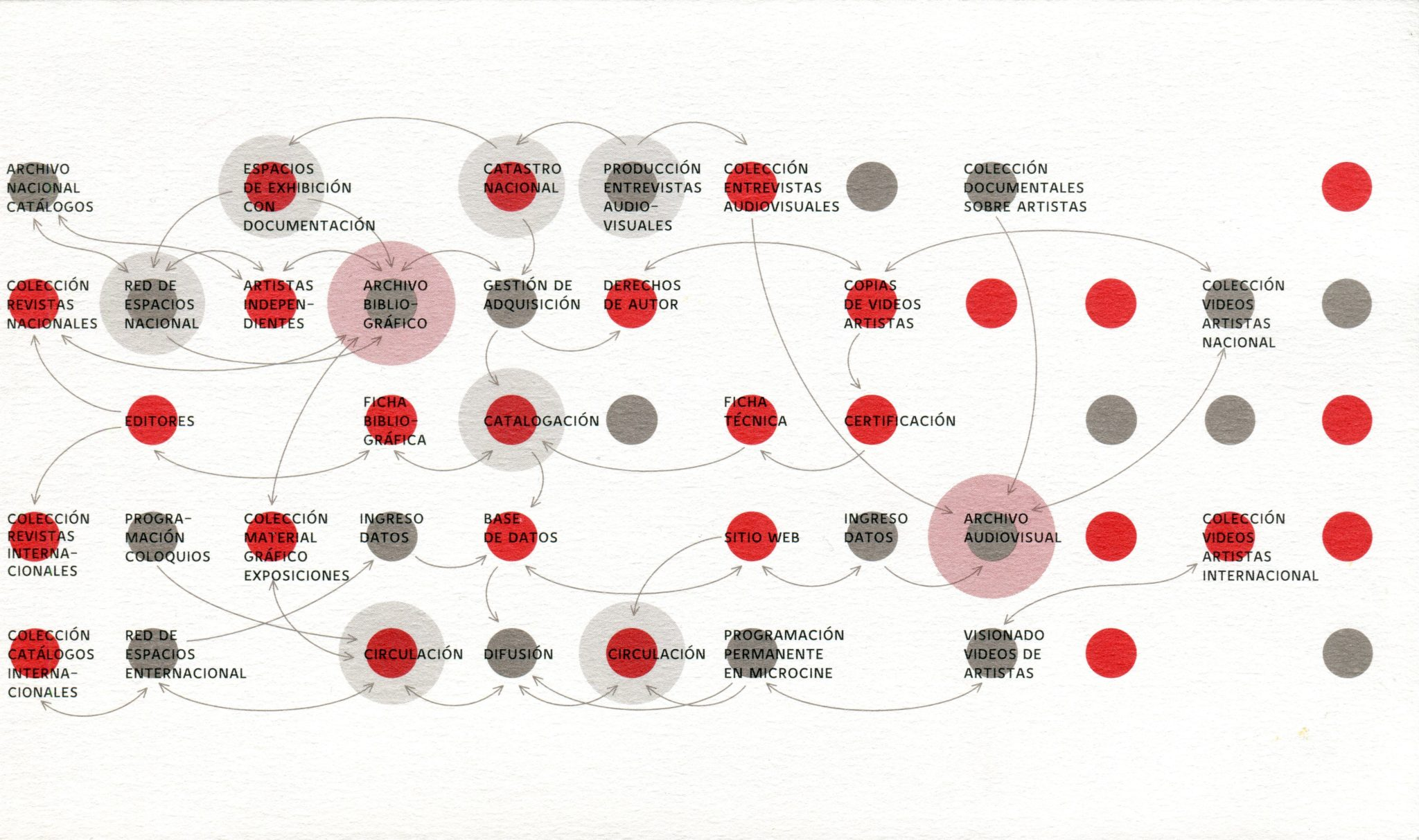
In this way, for the last 12 years in the center located downtown, those who have worked in the space have been able to create diverse bibliographic and audiovisual collections, from graphic material taken out from exhibits, catalogs, interviews, among others.
Along with the documentation gathering task, different strategies for the dissemination of the doing and practices have taken place (as exhibits and activation of archives), as well as fostering the Essay Contest Of Visual Arts to promote research. Its development has allowed the field’s research work from young artists to become available and visible.
Since its inauguration up to date, CEDOC has faced different challenges. Most of them are related to changes in the people that compose the teams, as this process has impacted decision making within the organization, how the work is disseminated and shelter (both virtually and physically) as well as the relationship with the medium, that has turned more relevant in time, considering the great interest show by other institutions, artists and researches that approach our Archive of Visual Arts.
Bearing this in mind, as we are close to turning 16 years old, the current staff has felt the need (and almost the obligation!) to review the documents produced throughout its history to see which are the next steps to follow.
Considering CEDOC’s management, -and as a consequence of the reviewing of the archive documents we have done, more specifically of CEDOC’s Archive Holding-, we have encountered important aspects that have been addressed since its opening, and that continue to be in force in current management. Just to mention two main elements, we can talk about copyright issues, which has permanently presented itself as a challenge, and the publishing of an online catalog, as a main source to access the collections. Both items on the lists demand from us a constant reviewing of the institutional archive in order to attend decisions made by previous teams and, from that point on, think about the future of these and other key instruments that would benefit the growth of CEDOC and the fulfillment of its objectives.
For the purpose of classification, we have prioritized two stages of our institution’s history (known also as a Holding Producer): CEDOC from 2006 to 2007, and CEDOC from 2018 up to date.
This comes after CEDOC was ceded on loan to the National Center for Contemporary Art in 2018, through an agreement between La Moneda Cultural Center Foundation and the National Council for Culture and Arts (later on named Undersecretariat of Cultures and the Arts from the Ministry of Culture, Arts and Heritage, MINCAP).
As part of one of the Ministry’s measures, the National Center for the Contemporary Art (CNAC) was opened in 2016, and its mission was to promote and stimulate the creation, experimentation, reflection and comprehension of Chile’s contemporary art, in connection with the Latinamerican and International artistic scene, having as a main axis the research, as well as the preservation and enhancement of the “contemporary heritage”, thus becoming accessible thanks to the implementation of different actions.
By being located in a new institution and in the context of a National Policy for Visual Arts 2017-2022, certain actions and objectives were delimited, one of which establishes that the Center must “contribute to the promotion, preservation and recognition of the collections and archives linked to the visual arts in the country” (Ámbito Patrimonio Cultural)(CNCA, (s.f), p. 88).
In regards to the documentation and archive, this policy also mentions that it becomes necessary to keep up with pointing out that: “working on the piece is not enough, it must also be considered the multiplicity of processes and the objects that compose the heritage, such as exhibit programs, catalogs, documents linked to curatorship [and] technical documents on the setting up”. (CNCA, (s.f), p. 33-34).
Currently the CEDOC/CNAC continues to promote the preservation, the study and dissemination of its publications and archives, with the objective of becoming a platform for the documentation, research and dissemination of the heritage regarding contemporary national art. It also seeks to promote the investigation through different actions, such as supporting and paying attention to specialized researchers and instances that encourage the production of knowledge as the Essay Contest of Visual Arts, which this year will have its 10th publishing and its 11th Open Call.
Within this framework, we would like to share two programs that have been recently developed. The first one is the ‘Regional Archives of Contemporary Art Program’ that had a first stage in the Chiloé’s Museum of Modern Art and a second one in Los Lagos Region last year.
This Program was a great challenge, as it sought to support the retrieval, preservation and access to collections of documents that were connected to the Visual Arts in diverse territories all over our country. This resulted in a national survey that would allow us to observe the problems that can be found in document holdings.
And the second one is the “Contemporary Art Archive Program ‘’, in which it is framed, just to mention an example, the loan of the Guillermo Deisler Archive. In October, 2021, this archive -composed of over six thousand documents and artworks-, was handed in bailment to MINCAP, to be kept in the CNAC, and today is permanently consulted by national and international researchers.
Both programs were created with the aim of becoming a permanent source for the identification, preservation, dissemination and access of relevant document holdings for the study of Chile’s contemporary art, thus fulfilling the National Policy for Visual Arts 2017-2022.
Also, just to do a recap on the institution’s history, one of the main lines of work of CEDOC started in its beginnings and hasn’t been mentioned yet: the creation of Work Sessions on Archive Policies in Art.
These started back in 2015, in a first instance convened by the leading team behind the Yeguas del Apocalipsis Archive, Fernanda Carvajal and Alejandro de la Fuente, created in collaboration with CEDOC’s team composed by Soledad García Saavedra (2010-2016), the referencist Sebastián Valenzuela (2015-2018) and the biotechnologist, Miguel Herández (2012-2017).
The invitation extended for these first sessions pointed out that its purpose was to “create a space for the reflection and the collective debate regarding methodologies, conceptual strategies and policies applied when working with records”[^1]. Invitations were personally handed to those who work with artist’s archives to discuss four proposed axes: Architecture of the Archive, Records Usage Policies, Archive Economy and Poetics of the Archive. The invitation considered 3 questions with each axis that had as an objective to reach clearer answers in relation to the questions proposed, but also to digest and share reflections on the actions done in the process.
The session gathered 26 professionals, from different disciplines, which were working on Archives related to the Visual Arts, from private archives to institutional artchives, or archives that belonged to organizations (both public and private).
The record from the session on October 23, 2015, had an 18-page extension, where different discussions took place. Each theme is highlighted in a given phrase to showcase in an organized way, bullet points with the arguments that emerged that day. Each paragraph ends with the name of the author that did the intervention.
Page 18 closes with the title ‘Pending themes’, stating that: “In relation to the public policies on archives, in a context where there are no national policies on the archive, a question was left remaining on how to collectively act to contribute in this area”[^2].
We go back to this document six years later (2021), as a new team post-revolts and post-quarantines, that considers the need to continue with the sessions that have been held periodically since that first day of 2015.
In order to think of a new encounter (this 2022) we have had to go back to review previous sessions and the different dynamics held in each of them. We think it’s extremely relevant to understand that these encounters, that have been occurring annually for 4 years (2015-2018), emerge from the will of those working on archives connected to the Visual Arts, and from the need to share their work experiences and meet those who can offer other possible solutions.
These personal and institutional wills gave rise to a third encounter (2017), in which a public program from La Moneda Cultural Center was established (program created by Ignacio Szmulewicz, CEDOC coordinator in 2017-2020, Sebastian Valenzuela and Miguel Hernández), that was disseminated by social media with the aim of giving a chance to different audiences which were interested to participate in the presentations via a registration form. This last encounter took place in La Moneda Cultural Center.
A year later, the 2018 gathering, was also organized by CEDOC, but in this opportunity the encounter took place in a new setting: the National Center of Contemporary Art, which meant not only a change of the physical place but also the transferring of CEDOC to the Undersecretariat of Cultures and Arts.
In this new scenario, Ignacio Szmulewicz once again personally contacted those connected to the archive in Visual Arts, as it was done in previous years. The sessions would take place for three days in Chiloé’s Museum of Contemporary Art (in Castro, Los Lagos Region).
This time, the meeting was framed in what was the register of Archives of Visual Arts that gave continuity to the sessions held with different art museums on the creation of the National Visual Arts Policy.
This time, the encounter focused on the cadastre of Visual Arts records that provided a continuity of the working tables done with different museums in the rise of a National Policy for Visual Arts 2017-2022.
For this four encounter, the names of those who participated before became familiar, and from a couple of years, many of those who participated in these sessions kept in touch for the sake of friendship and curiosity on the work made in other archives.
The different archives that were summoned year after year were acknowledged in the report: ‘The State of Contemporary Art Archives in Chile: Definitions, opportunities and requirements from the sector’ (Informe: Estado de los Archivos de Arte Contemporáneo en Chile: definiciones, oportunidades y requerimientos del sector)[^3] published in 2019 by the Macro Area of the Visual Arts (Macro Área de las Artes de la Visualidad, AA.VV.), together with CEDOC, both from the Undersecretariat of Cultures and the Arts from MINCAP, and created with the objective of “developing indications that aim to the implementation of the National Policy for Visual Arts 2017-2022”.
After this brief account of actions, documents and challenges, as a team we concluded that there is a lot to be done yet. The exposed requirements in the cited Report summarize the discussions and observations that were presented in every session. In response to this, we think it is fundamental to show the development of these sessions and position ourselves from CEDOC’s public role to contribute to the needs of the medium in a concrete way, which reveals the personal and institutional wills that have been forged and acknowledged on Art Archives in Chile along the way.
So from this revision, we would like to share some of the questions that we have gotten to as a team and that we believe can serve as an invitation to meet again.
We are developing three work lines.
The first, which we considered to be a key work line in the community of archivists, is to critically assess the archival criteria that have supported the denominations and treatments of the documentary sets that we guard. On more than one occasion, as a team, we’ve asked ourselves: Why is the basic concept almost unused in the archive? And if we have the premise that the use of the concept of ‘holdings’ is a consequence of the application of the principle of provenance, it is worth asking ourselves about the application or archival principles in our institutions. Keeping the document’s origin link with its producers, and within the relationships between documents, is key for our work.
Other recording or archivist principles, as the one of the integrity of a holding, should serve as a basis to tip off the community on how the art archives are worked when, for example, we become witness of the fragmentation of archive holdings, thus warning when a institution only buys one part of the archive: What happens with the rest of the documents? How much information is lost when only ‘the important’ is selected? How can we keep the relationship between the documents, if that organic grouping is lost? These, just to mention a few.
We know that the practical application of these fundamental principles in the archive in different contexts is not an easy task, but it must be done hand in hand with the artists, who are responsible for providings legacies, art collectives, institutions in the art field and of course, archivists.
Another line of work is related to the challenge of working with archives that constitute political spheres where functions and activities of those who produce it can be reflected upon, whether as an artist or as institutions in the art field. This is an invitation to reflect on the importance and the need of writing the history of the archive institutions, with the objective of sharing criteria and decisions with which we have shaped the collections, in a post-custodial context in which it is imperative to account for out subjectivities when defining what is “admitted” in our institutions.
For it, we are convinced that we must deepen in the self-identification of CEDOC as an institution that produces; this will allow us to identify policies in a retrospective way, and will enable us to present them in the present and in the future considering the memory path, by defining and transmitting a clear role, from the public aspect, in order to be a contribution in the preservation of the record heritage linked to the Visual Arts. This will help to set the criteria and archive policies understood as decisions and actions related to the production, use and preservation of archives (which we guard), which we considered to be an ethical task for transparency with the community.
In 2021, a new process of execution, evaluation and diagnosis took place for the Digital Preservation of our Audiovisual Collection. This, with the aim of collecting historical information on the audiovisual collection and documentation associated with usage permits and consultations by authors and donors found in CEDOC since its origins. The objective is to delimit the intellectual and technical universe of the audiovisual archive in order to create, in this way, a digital preservation plan according to the needs of the collection in this new institutional context.
Initially, the CEDOC’ audiovisual collection originated as a group of digital documents that arise from the gathering of audiovisual works from Chilean artists, thus adding video-art titles and audiovisual documents linked to these types of themes. Due to the resulting diversity of formats given by the technological evolution associated to audiovisual documentation, it was key to have the support of the National Film Library (Cineteca Nacional) to take these titles into a format that could be more easily consulted and which could deal with technological obsolescence.
Within the current challenges we face, we can find the coexistence of video-art workpieces with documents; something that makes it hard in terms of description and technical considerations, as well as to the required level of documentation. The usage authorizations and questionnaires for artists are key in the access and insurance of future consultation and usage of these exhibits. Also, we have strengthened the role of CEDOC/CNAC as a consultation and access point for audiovisual material, due to its collections’ characteristics. This also leads to a challenge in terms of creating a digital preservation plan that goes in line with the institutional needs, considering the consultation and usage of audiovisual documents that will become digital in the medium term.
That is why, with the previously mentioned, it is also important for us to participate and contribute in current discussions on storage, preservation, access and projections of video-art inside the institutions. This can be reflected both in the internal work we do as well as in the usage of what we have reached with this work, whether in the collaboration with external investigations or in the actions and activities that had been developed in the National Center for Contemporary Art. That is the case of the exhibit ‘40 years of the French-Chilean Video-Art Festival’ (40 años del Festival Franco Chileno de Videoarte), which has exposed the urgency of including specific guidelines in the documentary and technical management within protocoles in the seleccion of Chilean and French artists’ audiovisual workarts.
References
Centro de Documentación de las Artes Visuales (CEDOC), Centro Cultural La Moneda (CCPLM). (23 de octubre de 2015). Jornada de trabajo sobre políticas de archivo en arte. En Fondo Centro de Documentación de las Artes Visuales del Centro Nacional de Arte Contemporáneo, Carpeta Antecedentes Jornadas de archivos. [Acta de reunión].
Consejo Nacional de las Culturas y las Artes (CNCA). (s.f.). Política Nacional de las artes de la visualidad 2017-2022. https://www.cultura.gob.cl/politicas-culturales/wp-content/uploads/sites/2/2017/08/politica_aavv.pdf
Ministerio de las Culturas, las Artes y el Patrimonio. Macro Área Artes de la Visualidad, Brodsky, V., Coddou, F., Pérez, S., Prieto, R., Centro de Documentación de las Artes Visuales – Centro Nacional de Arte Contemporáneo, Szmulewicz, I., Novoa Donoso, S. y Sims Rubio, I. (2019). Informe: Estado de los Archivos de Arte Contemporáneo en Chile: definiciones, oportunidades y requerimientos del sector.
Brief Institutional Review
The Documentation Center for the Visual Arts from the National Center of Contemporary Art
(CEDOC/CNAC) guards, studies and disseminates publications and archives, with the objective of becoming one of the main documentation, research and dissemination platforms of contemporary art in Chile.
It seeks to enhance the research through different actions, suchs as the support and keeping up with the work of specialized researches; instances that promote the production of knowledge like the case of the Essay Contest of Visual Arts (annually) or the Glossary of Contemporary Chilean Art that is periodically re-edited with the collaboration of diverse voices and overviews.
Likewise, it collaborates with the safeguard and protection of record heritage linked to the Visual Arts, as well as with the organization and dissemination of activities such as seminars and conferences on the subject. CEDOC/CNAC has in its power collections granted by the La Moneda Cultural Center back in 2018. Since then, it has increased its collections that are currently organized in different categories like the Historical, Audiovisual Collection, Depository, Guillermo Deisler Archive, among others, which can be consulted through its Online Catalog.
Presentation collectively written by CEDOC/CNAC professionals, composed by
Paola Letelier: Information Manager, Librarian and Archivist. Diplomate in Electronic Documental Management. In charge of the CEDOC/CNAC library management.
Isidora Neira: Art Historian and Archivist. She is part of the team in charge of the Guillermo Núñez Archive. She is part of the Network of Conceptualisms of the South (Red de Conceptualismos del Sur) which is part of the Archive Node. In charge of the CEDOC/CNAC references and archive management.
Jeannette Garcés: Specialist in Audiovisual Collection Management and Preservation. She has a Degree in Arts specialized in Sound and Sound Art Diplomate. She has been a speaker and a scholar in multiple seminars, sessions and programs in the Chilean and Latinamerican Area.
Paulina Bravo: Recorder. She has a Degree in Theory and History of Art. Masters in Documentation, Library and Archives Management. She teaches courses on Archive to undergraduates and postgraduate students. CEDOC / CNAC Coordinator.