VIII. Is there memory without looting?
- Sol Henaro, UNAM
The title seeks to provoke. I took it from a dialogue in the movie Museo (‘Museum’, Alonso Ruizpalacios, 2018) that shows the 1985 heist of several heritage pieces from the Mayans and the Aztecs that were in the National Museum of Anthropology and Mexico’s City History. In one of the scenes, one of the ma∫”, and from that point on, the phrase remained as an inquiry in my everyday reflection, though in my case it presented itself with a question mark: Is there memory with no looting?
Leading this questioning to practices related to the memory policies, shades and reflections were thrown on the ethical limitations, the relativity of the justifications and the violence or relevance of certain practices, agencies, wastes or productions. From my point of view, it depends on where, with which purpose and how displacement or integration unfolds.
What type of action steps do we take and which are the strategies or meaningful choreographies we project in order to achieve our goals? Which trust policies do we develop and which autocritical position do we stand on in our professional practices in terms of documents? Of course, the questioning structures most of our daily reflections from the Arkheia Documentation Center MUAC (DiGAV-UNAM) and our doing as researchers, archivists, custodians and agents that articulate, produce and easen the information and also intervene in the policies on memory.
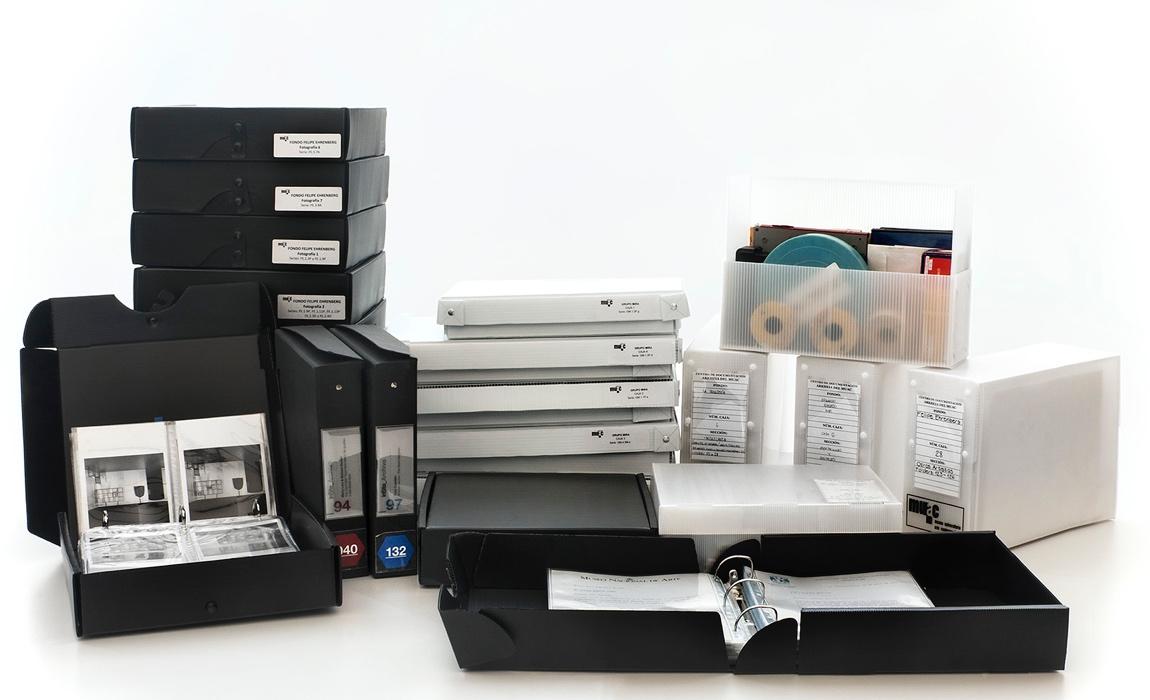
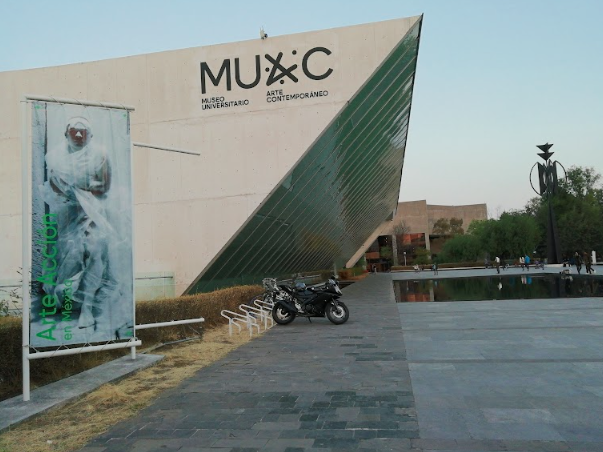
Let’s place where we act on. The Arkheia Documentation Center arose as a museological project which gave rise to MUAC, University Museum of Contemporary Art, which opened its doors in the south of Mexico City in 2008. Among the collegiate agents that intervene in its construction, the voice of Oliver Debroise, historian, critical and outstanding curator is highlighted. Sadly, he passed away soon before the opening date of the museum. Oliver provided substantial modifications in relation to the MUAC Collection and more accurately, on the documentary collections. He did right on providing a space and an equal status for the artistic and documentary collections, that, as you may know, tend to be placed in a secondary role. That is to say, Debrois objected to the tradition by understanding the artistic work as a main asset and as something complementary or accessory to the document or the archive. Next to this, he also widen the ratio of interest by recognizing the archives from artists but also from those that came from an extended community that’s actively participative in the artistic doing: critics, historians, museologists, museographists, independent spaces and other agents that are part of the artistic and cultural production and circulation.
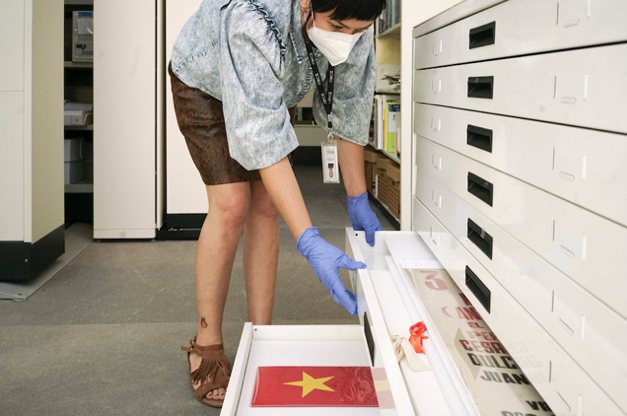
Conceived as a space for public service, Arkheia gives meaning to the library (bibliographic collection), holdings and documentary collections with the aim of widening and strengthening the historiographical storytelling of the artistic doings in Mexico since the 60’s. Among its services, it offers consultation of bibliographical and documentary inputs, it loans part of the collections for national and international exhibits, as well as digital archives for academic use and its dissemination, besides actively participating in the contexts and enclaves where the team is invited to present the project or reflect on policies regarding memory. Though the commitment to the material culture and preservation is nodal, we consider that public consultation is also a strategy for the activation, preservation of the memory and materials in itself.
In hand with the commitment towards public service, we bet on countering the twisted idea that archives are boring places or places for meta specialized audiences, thus, with the interest of approaching new users, we ask ourselves how to make “the archive sexier”, to lure and access new audiences.
Our first documentary holding was the Historical MUCA Holding that gathers precisely the institution’s history and its collection: the University Museum of Ciencies and Arts from UNAM, which has been actively working since the end of the ‘50s up to the opening of the new museum: MUAC. From that first archive, we have been able to add more more than 56 documentary funds plus 3 more documentary collections up to date; to each of these meaningful pieces a series of steps took place in order to extend and guarantee its public access: stabilization and restoration processes, catalogin, layering, guard production, transfer to guards, digitalization, reprography, dissemination…
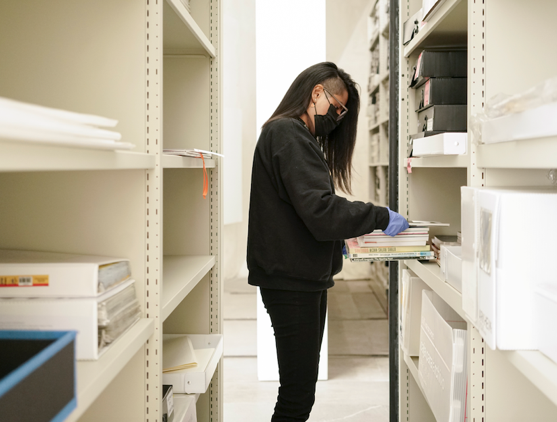
Taking seriously the responsibility of these legacies, MUAC has promoted, from the start, the creation of policies and guidelines with the purpose of professionalizing and guaranteeing the correct preservation of these. Equally, the CDArkheia has produced lines of works and a procedures manual to contribute to a structured study and reviewing of the processes culture, which must be taken into account and updated constantly. Certainly, recognizing that it keeps being a place in the making for the professionalization of the archives linked to the artistic practices of the museum institution. We constantly participate in training, visits to other collections, dialogues with colleagues and we periodically keep an internal seminary to socialize and collectively evaluate needs, limitations and complexities that accompany the everyday work.
A specific project that has called everyone’s attention in MUAC are the archive exhibitions, a strategy that opens a space for socializing and to create curatorial trusses from diverse documentary materiales that arise from different holdings and collections mainly from the Arkheia Documentation Center with some external loans that come from other archives or collections. The archive exhibitions, as any other investigation or/and curatorial exercise, seeks to manage the desire of prioritizing materials and allow us to rehearse with diverse models of museographic locations that attempt to convene contemporary, ludic and propositive languages that counter the common perception of archive exhibitions as dull experiences for the audience[^1].
![[Vista de la exposición: *Arte acción en México, registros y residuos.* 2019]. Cortesía: Museo Universitario Arte Contemporáneo, MUAC (DiGAV-UNAM).](../../img/figures/08/image7.jpg)
What do we map and preserve for the University’s Heritage? This, without a doubt, is immensely important. The University Museum of Contemporary Art -where is located the Documentation Center of Arkheia-, is a dependency of the General Visual Arts Direction from UNAM and surges to respond to the need for creating a collegiate, scholar and open memory which is key. For this, we sign on the pieces and documents in the General University Heritage Direction from UNAM. This operation guarantees the proper preservation of archives and the impossibility of being marginalized again; thus protecting them from certain individual decisions that might infringe or endangered the memory.
Even with the already depicted, we resist the idea of calling our work a sort of “rescue”. We feel less identified to that heroic dimension and much more close to the political responsibility of our practice. We are not doing any groundbreaking work as agencies that work on the archive already exist and have proved to have an impact in the development of art in Mexico. What we seek as an institution is to change the focus and throw a light on what is already there, “open the memory fold” and add ourselves to meaningful restitution operations. Certainly, and even though I don’t feel it is obvious, it shouldn’t be left unsaid that we believe in the existence of a full storytelling, we think more on microstories than a fixed and closed idea of History of Art.
How, with who and with which objectives are practices retrieved? It is not possible to cover the singularity of each of the holdings and documentary collections that we keep safe, so I will point out two examples. Though the collection we integrated into the documentary collection is the result of a research project and a complex administrative procedure, it is more common to take on already existing holdings and archives to create documentary collections that have not been articulated nor even thought of in the past. We willingly decided to dive in a complex and unusual process to articulate an active a documentation center for the creation of documental legacies that we think cannot be postponed: the Collection of Visualities and Social Mobilization, and the Collection of Visualities and HIV in Mexico (Colección visualidades y movilización social and Colección visualidades y VIH en México).
I became in charge of the Arkheia Documentation Center in 2015, a few months before the infamous disappearance of 43 students from the Normal Rural Raúl Isidro Burgos School in Ayotzinapa, Guerrero. In the rage, pain and displeasure that this caused, I asked myself how could we actively participate in the inflamed swarm; in the same way, the General Law of Archives was concomitantly discussed, which would come into effect and which we feared could be taken over by the Interior Ministry, which raised suspicions about possible deletions, obstacles to access documents and materials, as well as indiscriminate tests articulated from the State’s own personal interests.
In that moment of radical tension, I proposed to the Committee of Acquisitions of artistic and documental work (MUAC), an authorization to start a collection in process that would allow us to gather and guard diverse heterogeneous scraps from the visual culture produced to accompany or as interventions in the social protests.[^2] Composed of material produced by civilians, activists, designers and artists, the collection does not attempt to be exhaustive but it aims to shake the limits of institutions and of what a museum of contemporary art should or shouldn’t do, and call on the co-responsibility of the creation of memories.
To highlight a material from the Collection visualidades y movilización social I propose the Papalotes de los desaparecidos that the Oaxacan artist and activist Francisco Toledo produced with the faces of the 43 disappeared students, taking up a tradition of Zapotec origin that links earth and sky through the tail of the kites (papalote[^3]. Kids flew the kites in the street; Toledo sought through a powerful poetic image to narrate “how the students of Ayotzinapa were looked for on the earth and water, so now we search for them through the papalotes in the sky”.[^4]
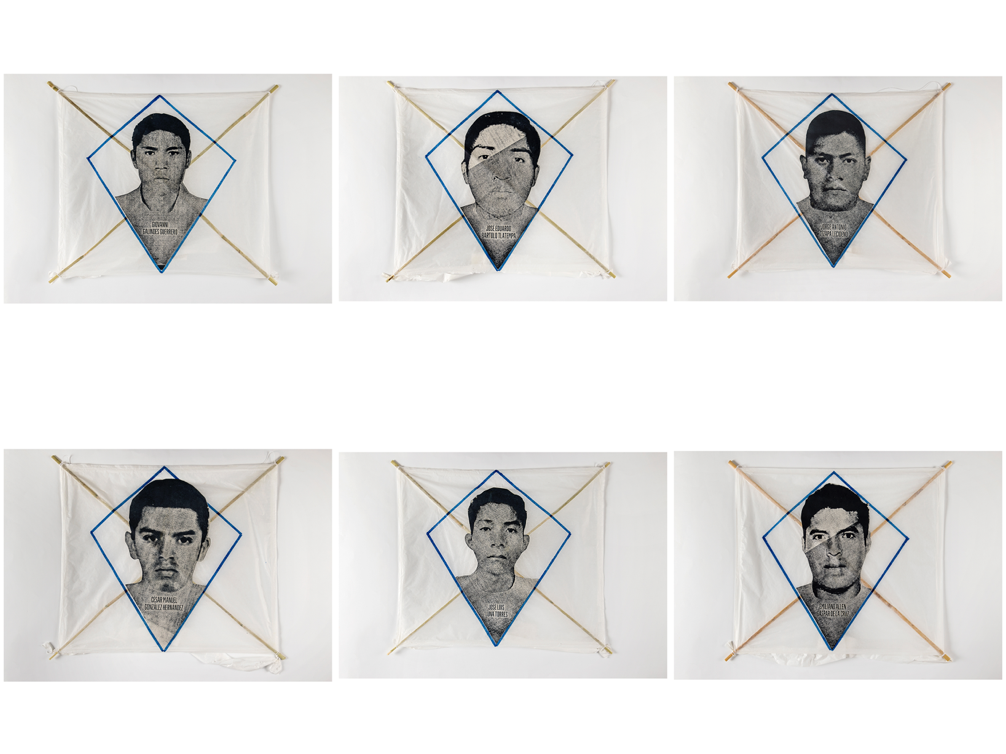
As you can imagine, the operation to gather all this heterogeneous origin scraps connected to the visual culture of the protest, faced problems and tensions. Since the start, we asked ourselves if with such exercise the museum was co-opting, neutralizing or promoting; we started a debate in order to act not naively, and take charge of the controversy that this could result in and understand which was the responsibility of the University Museum on the issue. By understanding that it was necessary to take risks and not abandon the articulation of such legacies, later on we started a second documental strategy that we titled Collection of Visualities and HIV in Mexico. We paid special attention to not place the word “art” in any of these collections in process and leave a wider framework of “visualities” in order to convene, from this elasticity, a plurality of materials without a limitation or association to that determined category.
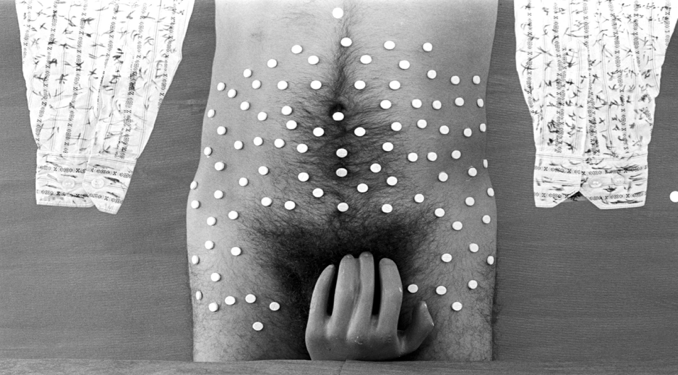
For the second partial repertory, we took as reference initiatives that precede us, such as the Anarchivo Sida, promoted by the Spanish territory by the Equipo Re[^5]. The trigger to fulfill the project was the desire for accompanying someone close who was diagnosed with HIV and whose experience led me to question my own stagnant and outdated knowledge in regards to the HIV pandemics; to remember the wordy cultural production that circulated in Mexico in the ‘80s and ‘90s in relation to the crisis of AIDS and to consider the emergency of bringing back the issue into the public sphere, specifically from a University Museum which has mainly a young audience. In this case, besides starting with the collection, we were able to set up an exhibition, a public program and a publication that, in the wake of the new COVID-19 pandemic had to close its doors, was published and adapted to socialize the contents and keep long distance researches during the pandemics. We seek to note the kindnesses that offer microsites as a powerful and useful tool for documental collection as it benefits the times of consumption, reading and login when reviewing the material that the independent user would like to see as many times he/she/they is possible, regardless of its geographical context; something that exhibits in situ cannot consider. In this case, new questions arise within the team who was in charge of creating this memory archive on HIV: Where do we place ourselves -in my case as someone who is not HIV positive-? How can we connect with the involved communities and how can we understand the project from a solidary and political accompaniment, and in co-responsibility with creating, gathering and dissemination of documentation with a respectful and in inprocess legacy?
The memory(-ies) is(are) in dispute. But maybe the main issue is not posed there but in what we ask ourselves, in what we’re-state and propose about it. The decision that we made affect, intervene, build and deploy… the memories are sensitive. I make a reference to current yet not new discussions in relation to the monument: I specifically remember an emblematic moment in 1992 when they overthrew the statue of the Spanish captain, Diego de Mazariegos in San Cristóbal de las Casas, Chiapas; a symbol of colonialism and racism. This action was a prelude to the uprising of EZLN a couple years later in 1994. The pictures that can be found from that event have troubled me. What meanings could be found and represented in the images, for the indigenous communities of the region? Somewhere, in the media, I read that one of the participants of the overthrowing said that even if they lift a new statue of the same subject, they would never feel fear again, the veil was taken off and the statue could never be seen in the same way again. These type of actions in relation to public sculpting, -the monument-, has repeated in different contexts and moments, many due to its relationship with other layers of memory that compromise and question a colonial past but also to what has happened in the last few years in regards to new feminisms and the desire to critically unveil patriarchal representations.
It is precisely there that question on ‘what belongs to who?’, ‘who decides what is placed in the public space?’, ‘what is represented symbolically and what does that mean to the communities that face this tridimensional body?’ unveil. In the disagreement, in the challenge or debate on new senses and readings, how do we connect to those memory scraps? During the first stage of the COVID-19 pandemic, when the isolation was a given, all members of the team of the Arkheia Documentation Center decided to see online movies and then discuss collectively with a drink in hand what they saw through the screen; a way to keep together and think collectively on the memory policies. One movie that we saw and discussed was Museum, from which the title of this text arises from; in other moment, we saw and talked about the movie La Piedra Ausente (The Absent Stone, Sandra Rozental and Jesse Lerner, 2013) that shows another real episode that happened in 1964: the moving of the monolith from San Miguel Coatlinchan in Texcoco to the National Museum of Anthropology in Ciudad de México, a Mesoamerican water deity (Tláloc or maybe more accurately the femenine deity Chalchiuhtlicue), which exposes the conflicts that emerge from moving a monolith inside the community for the sake of a “larger” circulation and dissemination of a national heritage. Loothing? Removal? What does a movement involve in a community when used to foundate and give meaning to others? What voids and which new senses collide?
In the heart of those discussion, I remember the text El paisaje en la ciudad: espectáculo, negocio y olvido (The city’s landscape: show, business and oblivion) that Rosa Olivares presented in the second International Symposium of Contemporary Art Theory (SITAC), titled Art and City, in 2003[^7]. In the text and later discussion, she suggested that we should ask ourselves what sculptures made sense and why should they be in the public space, which sculptures needed to be relocated in the urban geography, which ones should be kept for a determined time and motives, and which ones should be melted again. She was provocative, absolutely, but this text has blown my mind in regards to many other discussions that are taking place right now in the public sphere and in the right for memory, to “other” memory.
Probably you know the episode associated to the protests on new feminism and the backbone of the Ángel de la Independencia, or the Victoria Alada, located in the Paseo de la Reforma, Ciudad de México. After the massive protest on the 16th of August of 2019, the monument was visibly intervened by an anonymous group and a collective during the protests; immediately the disqualifications and convictions arose as an answer to the “vandalic acts towards the monuments”, and it was immediately ordered for the cleaning and restoration of the monument. To this, a group of professionals in charge of the safeguard of the heritage and preservation, clap back with their own political stances, questioning why it was so socially disowned and trying to stop the erasing of the things and slogans engraved in the monument… That is when the Restauradoras con glitter[^8] emerged. This collective in its immediate response against the growing number of feminices, made viral a brutal and much needed hashtags; #firstwomenthenwalls or #lifeisalsoheritage, to name a couple. Professionals in charge of heritage preservation didn’t deny attending the monument, but asked to stop and think on the new layer that coated the monument, as the engraved messages were a document of testimonies in itself and to consider the new shift of to whom and how the meaning of the monument becomes updated.
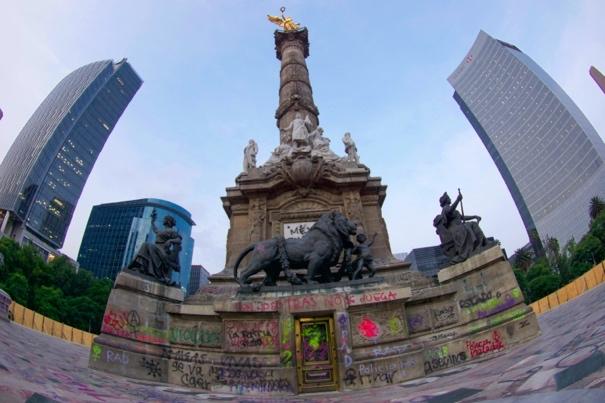
Melt? Clean? Erase? Update?, where do we place ourselves in regards to those actions? Is it the solution to erase? Isn’t it also erasing something that we are fighting against and resisting? Isn’t erasing also a form of violence? Also, if there was any doubt hanging, this also builds our past, our memory. Wouldn’t it be necessary to open the discussion on how to create critical frameworks, critical documents that frame these productions and memories in another way? Or do we really need to melt everything? I don’t think it is the path nor the solution.
Far from exhausting the reflection, I just wanted to pose some thoughts that interpellate our doing as the team of the Documentation Center. Reflecting on the memory as a matter. Our desire is not to operate wich inertia in the artistic/political field or in the memory/archive but rather ask ourselves, as I once listened that my friend and partner in RedCSur, Javiera Manzi, said: “How can we understand our militancy with the policies on memory? or better yet, how do we understand ourselves as activists within the archive?”.
“It is said that the best way to control a society is by extending on it a veil of un-memory. How many of us are willing to see beyond the fog?”[^9]